
Intelligence Without Action Is Just Information. CIPHER Changes That.
The adversary you haven't profiled is the one that surprises you. CIPHER gives your team the platform to build, maintain, and operationalize a living intelligence picture of every threat actor, every TTP, every malware family, and every campaign relevant to your environment — and connect that picture directly to the detection, hunting, and modeling capabilities that act on it.



Pillar Features — Problems CIPHER solves
The Intelligence Consumption Trap
The Disconnected Profile
The Spreadsheet Registry
The Relationship Nobody Mapped
The TTP Without a Detection
The RSS Feed Nobody Has Time to Read
The Entity Nobody Registered
The Hunt With No Intelligence Behind It
The PIR Nobody Can Answer
The Intelligence That Leaves With the Analyst
The Confidence Nobody Can Quantify
The Campaign Nobody Connected
What CIPHER delivers
Every Capability. Every Workflow. Every Detail of How CIPHER Turns Intelligence Into Action.
Know Your Adversary Before They Know Your Environment.
A threat actor profile that lives in a PDF report is intelligence at rest. CIPHER transforms that intelligence into an active, connected, operational asset — an AI-generated profile that captures every known attribute of a threat actor, maps every relationship to their tools, TTPs, campaigns, and infrastructure, and feeds every relevant detail directly into the detection, hunting, and modeling workflows that need it. The adversary is profiled. The environment is mapped. The connection between them is explicit.
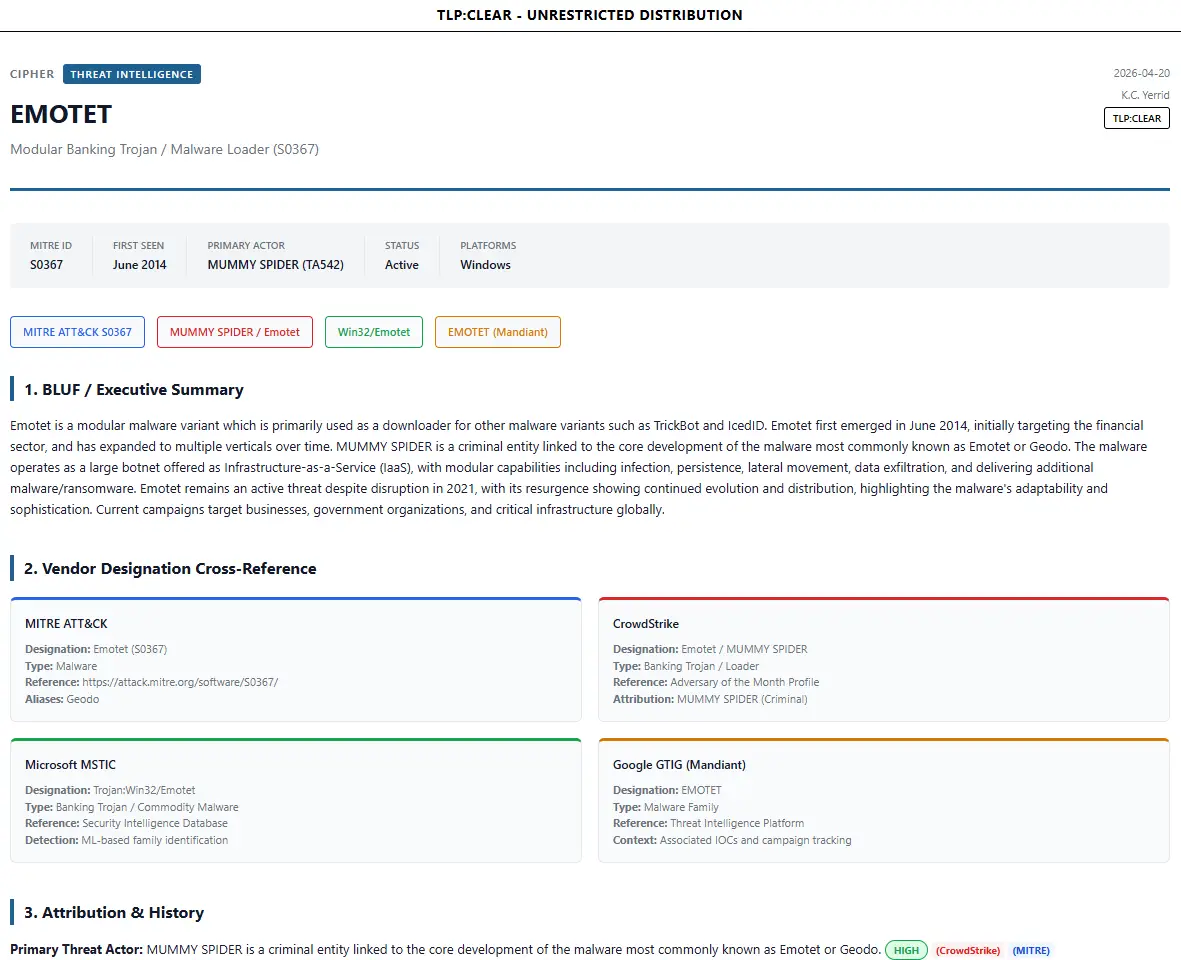
CIPHER generates comprehensive threat actor profiles using AI-powered research synthesis — drawing from MITRE ATT&CK, CrowdStrike, Microsoft Threat Intelligence, and GTIG to produce a structured profile covering actor attribution, nation-state affiliation, target sectors, known TTPs, malware families deployed, campaigns conducted, and infrastructure used. Every profile populates the entity registry automatically — creating individual entity records for every TTP, every malware family, every alias, and every nation-state attribution, and wiring the relationship edges between them. Profiles are generated on demand for any named threat actor and update as new intelligence is incorporated. The entire profile is searchable, referenceable, and connected to every other entity in the registry that shares a relationship.
Every Entity Known. Every Relationship Mapped. Nothing Isolated.
Threat intelligence is most powerful when it is connected. A threat actor in isolation tells you who to watch. A threat actor connected to their TTPs, their malware, their campaigns, their infrastructure, and their nation-state affiliation tells you what to detect, what to hunt, where to look, and what the blast radius looks like if they succeed. CIPHER's entity registry is the connective tissue of the SCOUT intelligence layer — every known entity documented, every relationship mapped, and every connection visible across the full knowledge graph.
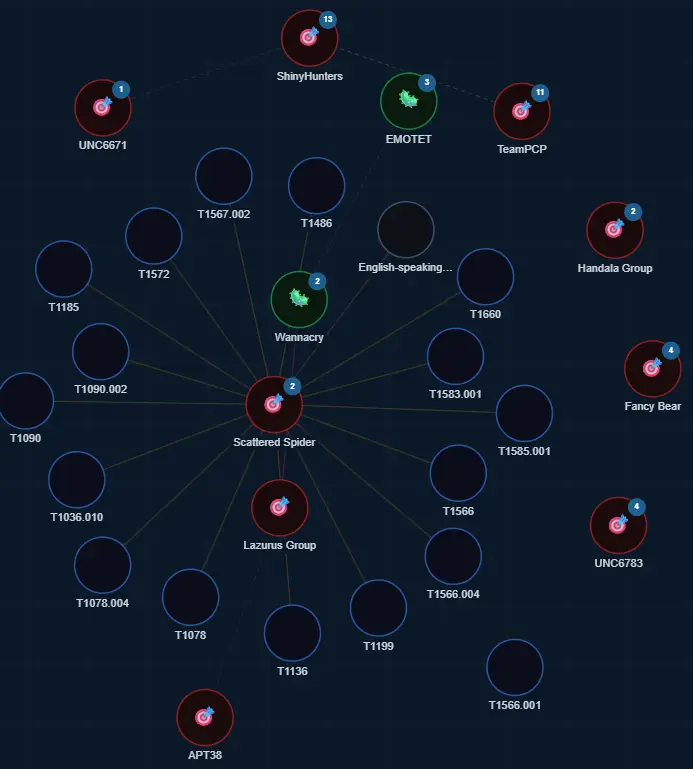
The entity registry stores every intelligence entity across eight types — Threat Actor, Malware, TTP, Vulnerability, Nation-State, Tool, Campaign, and Infrastructure. Every entity carries a structured record — canonical name, aliases, MITRE ID where applicable, confidence level, country of origin, activity level, source report, and tags. Relationships between entities are stored as typed edges — uses, deploys, attributed-to, targets, exploits, communicates-with — creating a queryable knowledge graph that surfaces the full context of any entity with a single click. The entity graph visualizes every relationship as an interactive network — nodes representing entities, edges representing relationships, and the full intelligence picture visible at a glance for any actor, campaign, or technique in the registry.
Every Intelligence Article Read. Every Relevant Entity Tagged. Nothing Missed.
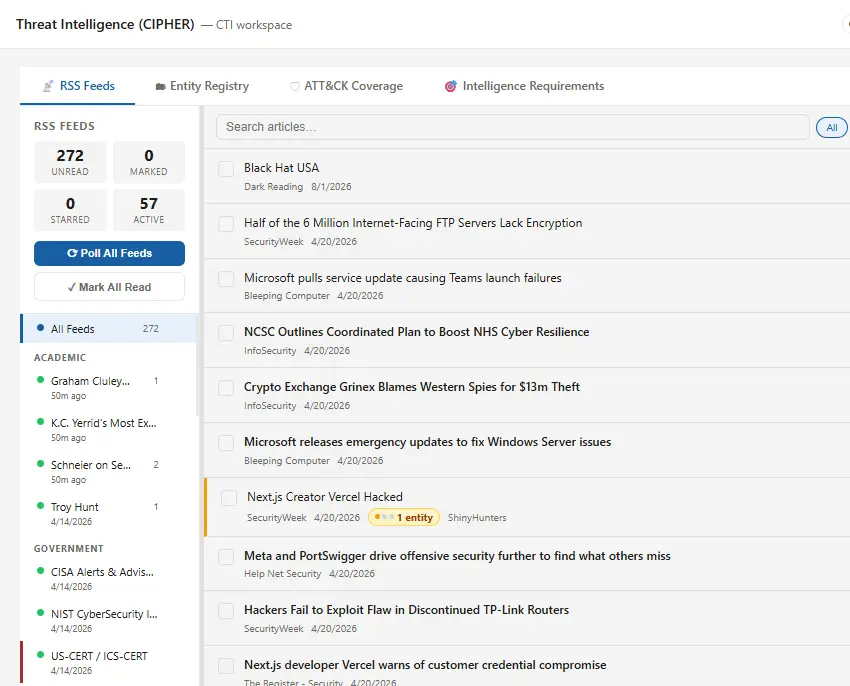
Body: Threat intelligence arrives constantly — vendor blogs, government advisories, ISAC feeds, research publications, and news sources producing a continuous stream of articles that collectively paint a picture of the current threat landscape. The challenge isn't access to that intelligence — it's processing it consistently enough to extract the signal from the noise. CIPHER automates that processing — aggregating feeds, scanning every article against the entity registry, and surfacing the intelligence that matters to your environment without requiring an analyst to read everything.
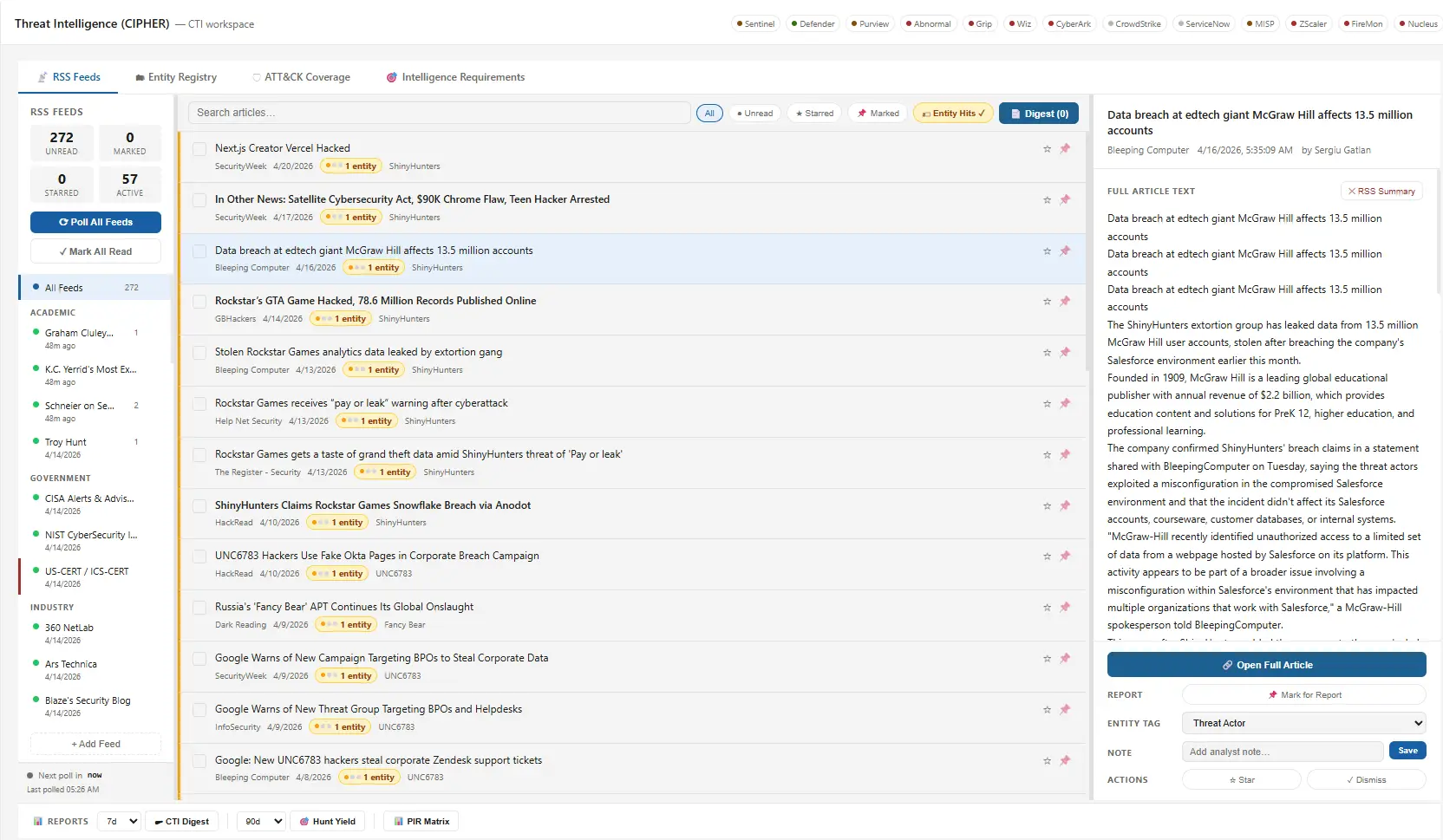
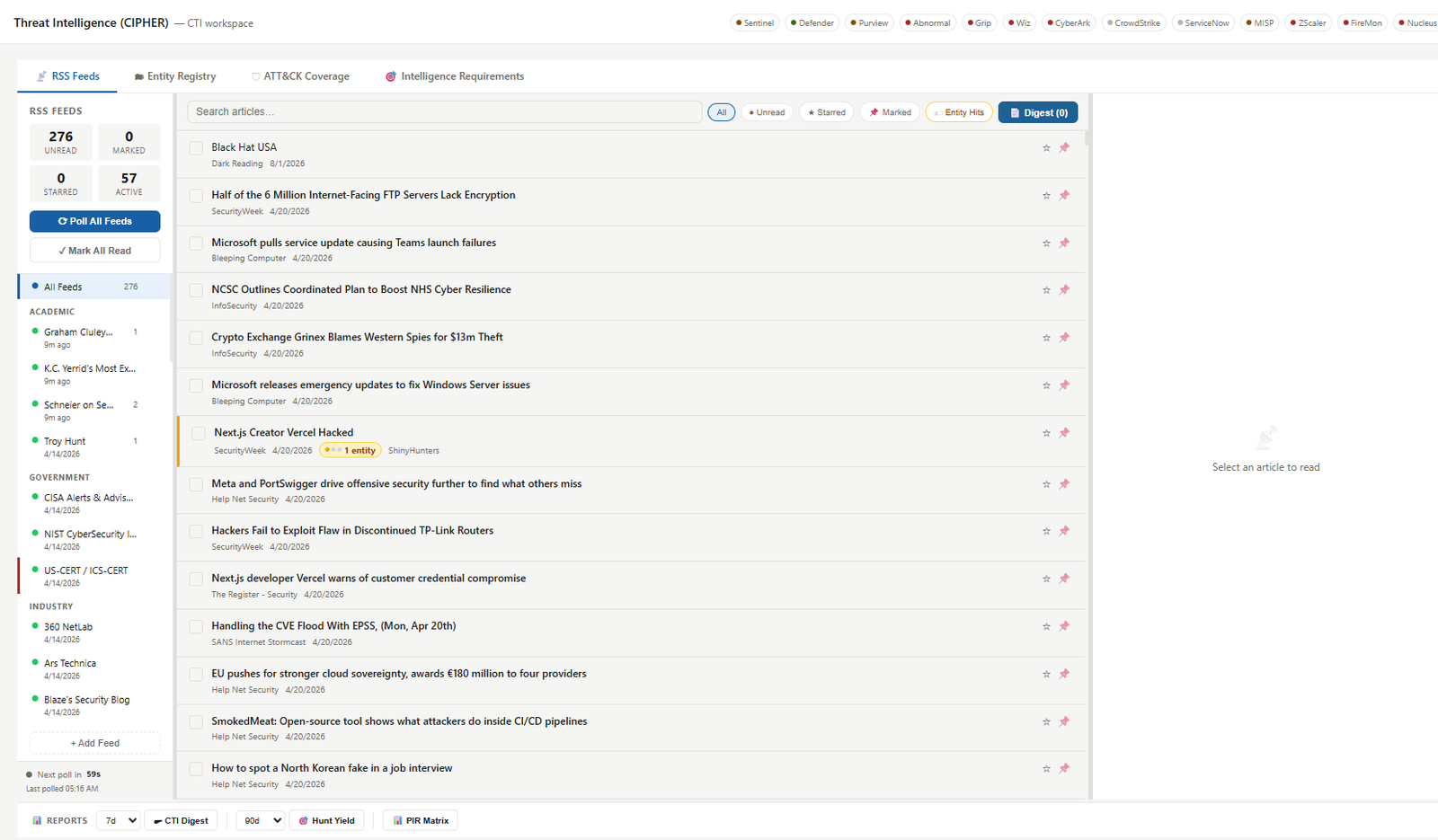
How It Works: CIPHER aggregates RSS feeds from configured intelligence sources — vendor blogs, government advisories, ISAC feeds, research publications, and news sources. Every article is scanned against the entity registry the moment it arrives — matching article content against every entity name, alias, and known indicator in the registry. Articles that mention registered entities are automatically tagged with the relevant entity names, surfaced in the entity's intelligence feed, and counted against the entity's article hit count — providing a real-time signal of increased coverage or attention for any actor, technique, or campaign in the registry. Unread article counts are tracked per feed so analysts can see at a glance where new intelligence has arrived. The FLARE Display Wall tag cloud visualizes the most prominent terms across recent articles — with entity registry matches highlighted by type.
Intelligence Collection With Purpose. Requirements That Drive Action.
Priority Intelligence Requirements define what the SOC needs to know — the specific intelligence questions that, if answered, would materially improve the organization's defensive posture. Most SOCs write PIRs and then struggle to collect against them systematically. CIPHER gives PIRs a structured home — tracked, assigned, reviewed on a defined cadence, and connected to the intelligence collection activity that answers them.
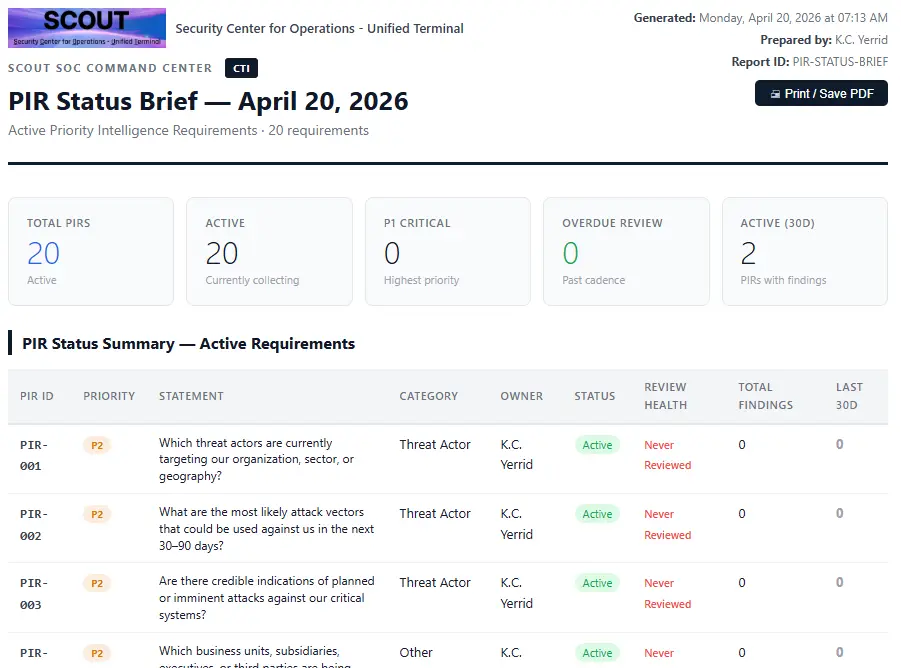
PIRs in CIPHER are structured intelligence requirements — each carrying a statement of the intelligence question, a category, a priority tier, an owner, a review cadence, and a status. Findings — individual intelligence observations that contribute to answering the PIR — attach directly to the PIR record as they are discovered. Each finding carries a source, a confidence level, a relevance assessment, and the analyst who documented it. PIR health is tracked against the review cadence — PIRs that haven't been reviewed within their defined window surface as overdue. The PIR status brief report surfaces the collection health of every active PIR — findings since last review, overdue flags, and owner accountability — giving the CTI lead a real-time picture of collection program health.
From Actor Name to Structured Intelligence Report — In Minutes.
Threat actor profiling is time-consuming work when done manually — cross-referencing multiple intelligence sources, synthesizing conflicting attributions, documenting TTPs, and structuring the output in a format the rest of the team can use. CIPHER automates that work — generating a comprehensive, structured threat actor profile from four authoritative intelligence sources in the time it takes to type a name. The report is the starting point, not the destination — every generated report populates the entity registry, feeds the hunt pipeline, and informs the threat model automatically.
CIPHER generates threat actor profiles on demand — the analyst enters the actor name, selects the report parameters, and CIPHER queries MITRE ATT&CK, CrowdStrike, Microsoft Threat Intelligence, and GTIG to synthesize a comprehensive profile. The generated report covers actor attribution, nation-state affiliation, target sectors, motivation, capability assessment, known TTPs with MITRE mapping, malware families deployed, campaigns conducted, infrastructure indicators, and recent activity. The report saves to the CIPHER report library and simultaneously populates the entity registry — creating entity records and relationship edges for every TTP, malware family, alias, and nation-state attribution in the profile. The full report exports as a formatted HTML document suitable for sharing, filing, and regulatory documentation.
The Weekly Intelligence Picture — Without the Weekly Intelligence Effort.
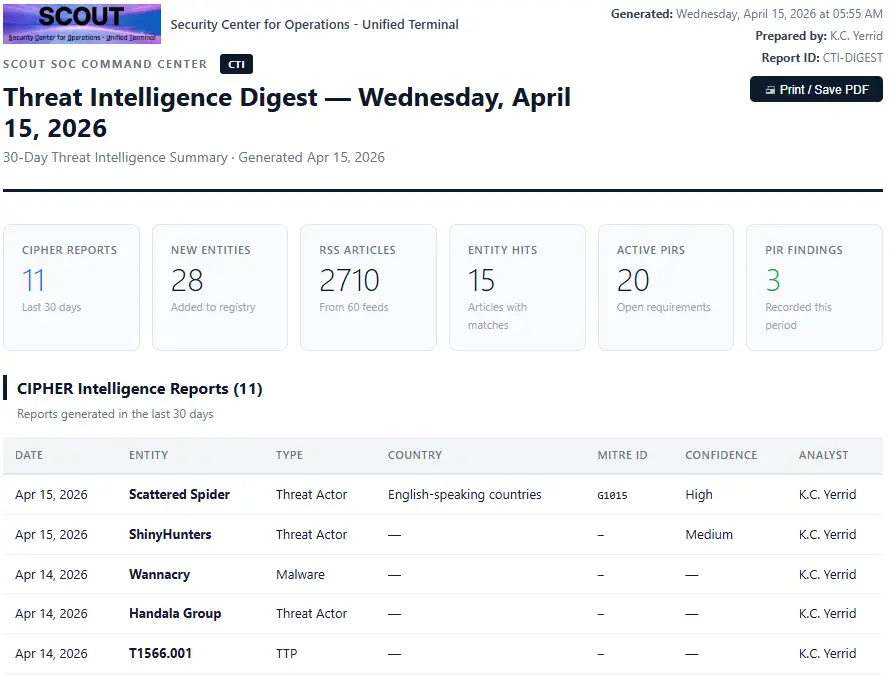
CTI reporting consumes significant analyst time — aggregating what was learned, summarizing what changed, and producing a document that gives leadership and the broader team a current picture of the threat landscape. CIPHER automates that production — a structured CTI digest that synthesizes recent CIPHER reports, new entity registry additions, RSS intelligence highlights, and PIR collection progress into a formatted briefing ready for distribution without manual compilation.
The CTI Digest generates automatically from the CIPHER data collected during a defined reporting period — typically weekly. It covers new threat actor profiles generated, entity registry additions and relationship updates, RSS intelligence highlights with entity hits, PIR collection progress and new findings, and threat landscape observations derived from article volume and entity hit trends. The digest formats as a structured HTML report suitable for email distribution, filing, and executive briefing. It exports on demand or on a scheduled basis — giving the CTI lead a production-ready intelligence briefing without the manual compilation work that typically makes consistent CTI reporting difficult to sustain.
Intelligence That Feeds Every Pillar. Context That Improves Every Workflow.
Threat intelligence is only as valuable as the operational workflows it informs. CIPHER is not a standalone intelligence platform — it is the intelligence layer that every other SCOUT pillar draws from, contributes to, and is made more effective by. Every profile generated, every entity registered, and every relationship mapped in CIPHER immediately enriches the detection, hunting, response, and modeling capabilities of the full platform.
CIPHER integrates directly with every pillar in the SCOUT platform through a shared intelligence layer. PROWL draws actor TTPs from CIPHER to generate targeted hunt hypotheses — surfacing relevant intelligence at the moment a hunter opens a new hypothesis. BLADE draws coverage gap intelligence from CIPHER — flagging actor TTPs that lack detection coverage and generating detection engineering requests automatically. SHIELD draws actor context from CIPHER during incident response — surfacing relevant actor profiles, known TTPs, and infrastructure indicators when a confirmed threat actor is identified in an active incident. TIME draws actor targeting and capability data from CIPHER to inform the threat model — understanding which actors are most relevant to the organization's specific environment and sector. FLARE draws entity hit data from CIPHER to enrich alert context — surfacing relevant actor and campaign intelligence alongside the alert that may be attributable to them.
How CIPHER works
From Intelligence Signal to Operational Action — Every Step Connected, Every Output Actionable.
Intelligence Signal Received
Actor Profile Generated
Entity Registry Populated
Relationships Mapped
RSS Feeds Scanned
PIRs Collected Against
Intelligence Fed to PROWL
Coverage Gaps Identified
Incident Context Enriched
Threat Model Informed
CTI Digest Generated
Registry Continuously Enriched
Frequently Asked Questions
If your CTI team is producing intelligence that never quite makes it into the workflows that need it — profiles that live in reports, TTPs that never become detection rules, PIRs that exist as documents rather than active collection programs — CIPHER was built for exactly that problem. Here are the questions CTI analysts, hunt leads, and security leaders ask most often about how CIPHER closes the gap between intelligence and action.
CIPHER — Cyber Intelligence Portal for Human-Enhanced Research — is SCOUT's threat intelligence pillar. It transforms raw threat intelligence into a living, connected knowledge base that feeds every other pillar in the platform. CIPHER generates AI-powered threat actor profiles, maintains a structured entity registry with full relationship mapping, aggregates and automatically tags RSS intelligence feeds, manages Priority Intelligence Requirements, and ensures that everything the SOC knows about the threat landscape is connected to everything the SOC does about it.
CIPHER generates threat actor profiles on demand using AI-powered research synthesis — querying MITRE ATT&CK, CrowdStrike, Microsoft Threat Intelligence, and GTIG simultaneously and synthesizing the results into a comprehensive structured profile. The profile covers actor attribution, nation-state affiliation, target sectors, motivation, capability assessment, known TTPs with MITRE mapping, malware families deployed, campaigns conducted, infrastructure indicators, and recent activity. Profile generation is initiated by typing the actor name — the synthesis, structuring, and registry population happen automatically.
Every generated profile is a registry population event. CIPHER creates individual entity records for every TTP, malware family, alias, nation-state attribution, and campaign referenced in the profile — and wires the relationship edges between them automatically. The actor connects to TTPs via uses edges, to malware via deploys edges, and to nation-state attribution via attributed-to edges. The registry grows with every profile — becoming more connected and more valuable as the intelligence picture develops across multiple actors, campaigns, and techniques.
The CIPHER entity registry supports eight entity types — Threat Actor, Malware, TTP, Vulnerability, Nation-State, Tool, Campaign, and Infrastructure. Each type carries a structured record with canonical name, aliases, MITRE ID where applicable, confidence level, country of origin, activity level, source report, and tags. Relationships between entities are stored as typed edges — uses, deploys, attributed-to, targets, exploits, communicates-with — creating a queryable knowledge graph that surfaces the full context of any entity with a single click.
The entity graph visualizes every entity and relationship in the registry as an interactive network — nodes representing entities, edges representing relationships, and the full intelligence picture visible at a glance for any actor, campaign, or technique in the registry. Analysts navigate from any entity to every connected entity with a single click — following the relationship chain from a threat actor to their TTPs, from a TTP to every actor known to use it, from a malware family to every campaign it has been associated with. The graph surfaces connections that would never be visible in a flat registry.
CIPHER aggregates RSS feeds from configured intelligence sources — vendor blogs, government advisories, ISAC feeds, research publications, and news sources. Every article is scanned against the full entity registry the moment it arrives — matching article content against every entity name, alias, and known indicator in the registry. Articles that mention registered entities are automatically tagged, surfaced in the relevant entity's intelligence feed, and counted against the entity's article hit count. Unread article counts track per feed so analysts always know where new intelligence has arrived.
PIRs in CIPHER are structured intelligence requirements carrying a statement, category, priority tier, owner, review cadence, and status. Findings — individual intelligence observations that contribute to answering the PIR — attach directly to the PIR record as they are discovered, carrying source, confidence level, relevance assessment, and analyst attribution. PIR health tracks against the review cadence — overdue PIRs surface with last review date and owner accountability. The PIR status brief report gives the CTI lead a real-time picture of collection program health across all active requirements.
CIPHER feeds actor TTPs directly into PROWL's hypothesis development workspace. When a hunter opens a new hypothesis, CIPHER surfaces relevant threat actors, their known TTPs, active campaigns, and recent RSS intelligence hits — giving the hunter a targeted starting point grounded in current threat intelligence. Hunt findings that confirm a known actor's TTP feed back into CIPHER — enriching the entity record with environmental evidence and strengthening the intelligence picture for every future hunt.
Every TTP in the CIPHER entity registry is checked against BLADE's detection rule inventory. Techniques that are known TTPs of registered actors but have no corresponding detection coverage surface automatically as detection engineering requests in BLADE — specifying the technique, the actor known to use it, and the intelligence source. The pipeline from intelligence to detection gap to engineering request closes automatically — ensuring detection coverage keeps pace with the intelligence picture.
When an active incident involves a confirmed or suspected threat actor, CIPHER surfaces the full intelligence picture for that actor within the SHIELD incident workspace — known TTPs, deployed malware, typical infrastructure, target sectors, and recent campaign activity. The response team sees the full adversary context without leaving the incident workspace — understanding what the attacker is likely to do next and what containment and eradication actions have been most effective against this actor historically.
The CTI Digest is an automatically generated intelligence briefing that synthesizes the collection activity from a defined reporting period — new threat actor profiles, entity registry additions, RSS intelligence highlights, PIR collection progress, and threat landscape observations. It generates on demand or on a scheduled basis and exports as a structured HTML report suitable for email distribution, filing, and executive briefing — giving the CTI lead a production-ready intelligence report without the manual compilation work that typically makes consistent CTI reporting difficult to sustain.
Every profile generated, every entity registered, every relationship mapped, and every RSS article tagged in CIPHER is preserved in the platform permanently — fully searchable and fully available to every analyst on the team. When an experienced CTI analyst leaves, the intelligence they built stays in the registry. The threat actor profiles, the entity relationships, the PIR findings, and the tagged article history are all properties of the platform rather than the individual — the program retains the knowledge even when it loses the person.
Every entity in the CIPHER registry carries a confidence level — a documented assessment of how reliable the intelligence supporting that entity record is. Every PIR finding carries a confidence level and a source attribution. Every relationship edge carries the intelligence source that documented the association. Confidence levels are visible throughout the platform — in entity records, in hunt hypotheses that draw from CIPHER, and in the threat model context that TIME uses for gap analysis. The SOC's intelligence picture is always accompanied by the evidence that supports it.
Yes. CIPHER's AI-powered synthesis reconciles overlapping designations and conflicting attributions across its four intelligence sources — producing a single coherent profile that documents the primary attribution and notes alternative attributions with source references. When CrowdStrike, Microsoft, and MITRE use different names for the same actor, CIPHER resolves the canonical name, registers all aliases, and ensures that searches and references to any alias surface the correct entity record.
CIPHER is the intelligence layer that every other SCOUT pillar draws from and contributes to. FLARE draws entity hit data to enrich alert context. PROWL draws actor TTPs for hypothesis development. SHIELD draws actor profiles for incident response context. BLADE draws TTP coverage gaps for detection engineering prioritization. TIME draws actor targeting and capability data for threat model construction. Every pillar makes CIPHER more valuable by contributing findings back — hunt confirmations, incident attributions, and detection validations all enrich the entity registry that every other pillar depends on.
Discover the Impact of SCOUT Through Video or a Live Demo
Every threat actor that targets your industry has a profile — documented TTPs, known malware families, preferred infrastructure, target sectors, and a history of campaigns that tells you exactly how they operate. That intelligence exists. The question is whether your SOC has it, whether it’s connected to the workflows that need it, and whether it’s current enough to be useful when the moment arrives.
Most CTI programs answer no to at least two of those questions. Intelligence gets consumed but not operationalized. Profiles get built but not connected to detection rules, hunt hypotheses, or incident response context. RSS feeds get subscribed to but not systematically processed. PIRs get written but not actively collected against. The intelligence exists — it just never quite makes it into the hands of the analysts who need it, in the workflow where they need it, at the moment they need it.
CIPHER was built to close that gap entirely. An AI-powered intelligence platform that generates comprehensive threat actor profiles from four authoritative sources, populates a living entity registry with every TTP, malware family, alias, and relationship automatically, scans every incoming RSS article against the full registry the moment it arrives, manages PIR collection with structured findings and cadence tracking, and feeds actionable intelligence into every SCOUT pillar without requiring a manual step to move it there.
When CIPHER profiles a threat actor, PROWL immediately has the hypothesis starting point. When CIPHER registers a TTP, BLADE immediately has the coverage gap. When CIPHER surfaces an RSS article, the entity it mentions immediately has the intelligence hit. When CIPHER answers a PIR, the finding immediately has a home. The intelligence pipeline runs automatically — from the moment it arrives to the moment it is acted on — because the platform is built to make that happen.
If your SOC is ready to stop filing intelligence reports and start operationalizing them — CIPHER is where that starts.
SCOUT is available now. Watch the full platform demonstration and see CIPHER in action — from AI-powered profile generation to entity registry population, RSS intelligence tagging to PIR collection management, and the cross-pillar intelligence pipeline that connects everything the SOC knows to everything the SOC does. One hour. Seven pillars. Everything your SOC has been missing.






Operate Ahead of the Threat.
SCOUT is a unified SOC platform with seven purpose-built pillars — covering every workflow from alert triage to detection engineering — built by analysts, for analysts, at the speed modern threats demand.
Rated 4.9 of 5
SCOUT © All rights reserved
