
Your Alerts Show You What Was Found. PROWL Finds What Wasn't.
Attackers who know what they're doing don't trip detection rules. They study them, avoid them, and operate in the gaps between them. The only way to find those attackers is to go looking — deliberately, methodically, and with a clear hypothesis about where they might be hiding. PROWL gives your hunters the structure to do exactly that — and the pipeline to turn every finding into a detection that closes the gap permanently.




Pillar Features — Problems PROWL solves
The Alert Dependency
The Dwell Time Problem
The Unstructured Hunt
The Hypothesis Without a Home
The Finding That Goes Nowhere
The Coverage Nobody Can See
The Intelligence That Never Gets Used
The Hunt That Never Gets Documented
The Program Nobody Can Measure
The True Positive With No Follow-Through
The Repeated Hunt
The Hunter Who Leaves
What PROWL delivers
Every Capability. Every Workflow. Every Detail of How PROWL Finds What Your Alerts Miss.
Every Hunt Starts With a Question. PROWL Makes Sure It's the Right One.
Threat hunting without a hypothesis is just looking. A structured hypothesis — grounded in threat intelligence, informed by the environment, and targeted at a specific technique or behavior — is what separates a productive hunt from an afternoon of aimless log review. PROWL gives hunters the workspace to develop, document, and prioritize hypotheses before a single query is run — ensuring every hunt starts with purpose and ends with a documented outcome.
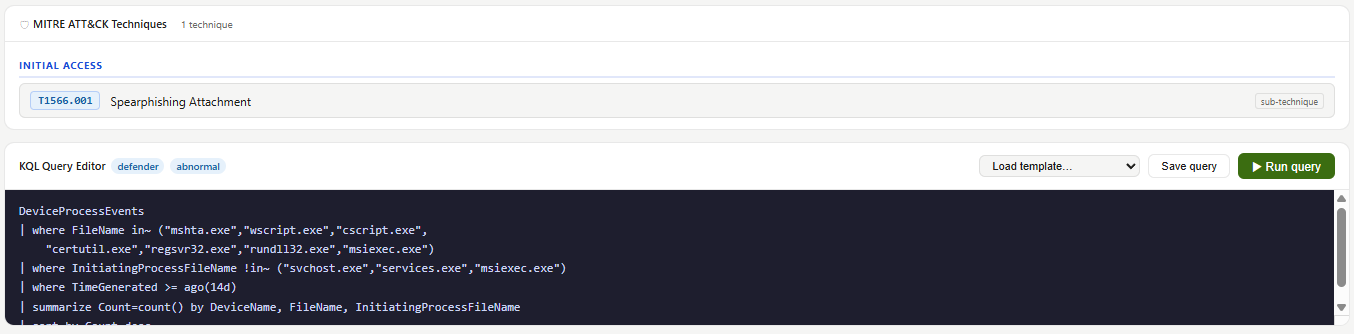
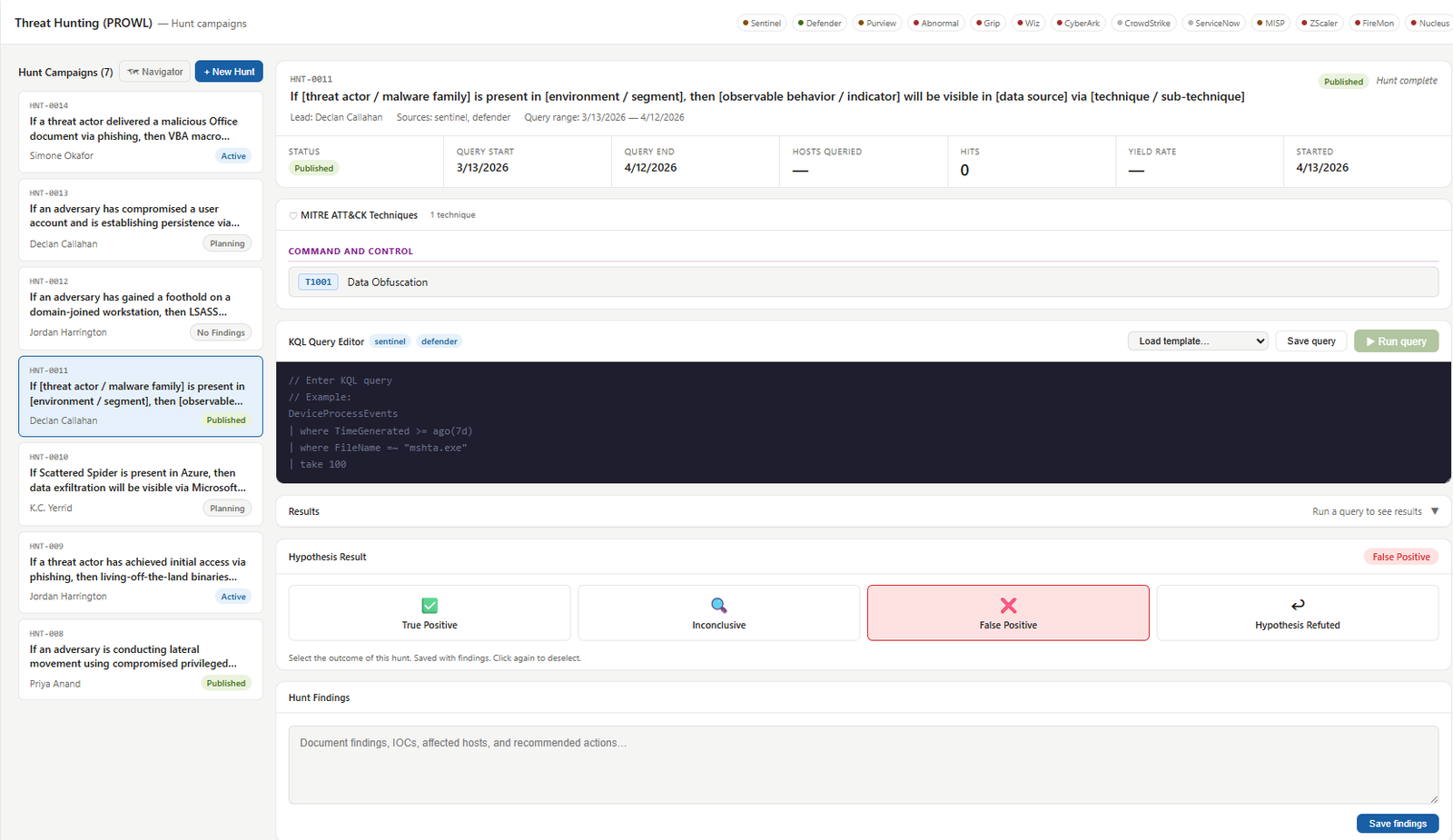
Every hunt in PROWL begins with a hypothesis — a structured statement that defines what the hunter is looking for, why they believe it might be present, which MITRE ATT&CK technique it targets, and what data sources will be used to investigate it. Hypotheses are documented in a standardized format that captures the If-Then-Via structure — if this actor is present, then this behavior should be observable, via this data source and technique. CIPHER feeds relevant threat actor TTPs directly into the hypothesis workspace — surfacing intelligence about active campaigns and known actor behaviors that give hunters a starting point grounded in real-world threat activity rather than intuition alone. Hypotheses are prioritized by risk, assigned to analysts, and tracked through their full lifecycle from creation to outcome.
From Hypothesis to Finding — Every Step Tracked, Every Action Documented.
A hypothesis is only as valuable as the hunt that tests it. PROWL gives hunters a structured execution workflow that documents every query run, every data source accessed, every observation made, and every decision taken during the hunt — building the investigation record that turns a successful hunt into institutional knowledge rather than a memory that walks out the door with the analyst who ran it.
Hunts in PROWL move through a defined workflow — Planning, Active, Findings Review, and Published or No Findings. Each stage has defined inputs and outputs that ensure the hunt produces a complete record regardless of outcome. During the active phase, hunters document their methodology — the queries they ran, the data sources they accessed, the observations they made, and the threads they followed and abandoned. Every note is timestamped and attributed. Every data source is logged. The hunt record builds itself as the work progresses — so the analyst who picks up a hunt in progress starts exactly where the previous analyst left off, and the analyst who reviews a completed hunt can replicate the methodology without asking.
Know Exactly Where Your Hunting Program Has Been. And Where It Hasn't.
Body: A threat hunting program without coverage visibility is flying blind. You might be hunting extensively — and still have entire tactics and technique families that have never been looked at. PROWL maps every hunt to the MITRE ATT&CK framework, building a live coverage picture that shows exactly which techniques have been hunted, which have produced findings, and which have never been investigated — so the program is driven by gaps, not habits.
How It Works: Every hypothesis and every completed hunt in PROWL carries a MITRE ATT&CK tactic and technique mapping. As hunts are completed, PROWL builds a cumulative coverage map — a living picture of which techniques have been hunted, how recently, how many times, and with what outcome. Techniques that have never been hunted surface as explicit gaps. Techniques that are known TTPs of threat actors in the CIPHER entity registry are flagged as priority coverage targets. The coverage map connects directly to BLADE — techniques with hunt findings but no detection rule generate automatic detection requests, ensuring that coverage gaps in hunting translate directly into detection engineering priorities.
Hunt Where the Threat Is. Not Where It's Comfortable to Look.
The most valuable hunt hypotheses aren't generated by intuition — they're generated by intelligence. Knowing which threat actors target your industry, which techniques they rely on, and which campaigns are active right now gives hunters the targeting information they need to focus their efforts where the actual risk is highest. PROWL integrates directly with CIPHER to bring that intelligence into the hunt workflow — turning threat actor profiles and TTP libraries into actionable hunt hypotheses grounded in real-world adversary behavior.
PROWL connects directly to CIPHER's entity registry and threat actor profiles. When a hunter opens a new hypothesis, CIPHER surfaces relevant threat actors, their known TTPs, their active campaigns, and any recent intelligence hits from the RSS feed that suggest increased activity. Threat actor TTPs from CIPHER map directly to MITRE ATT&CK techniques in the hunt hypothesis — giving the hunter a pre-populated starting point that reflects the actual threat landscape rather than generic technique libraries. Hunt findings that confirm the presence of a known actor's TTP feed back into CIPHER — enriching the entity record with environmental evidence and strengthening the intelligence picture for every future hunt.
A True Positive in a Hunt Is an Incident Waiting to Be Declared.
The moment a hunt confirms the presence of a real threat, two things need to happen simultaneously — the finding needs to be documented with enough precision to support an incident response, and the incident needs to be declared with enough context to give the response team a running start. PROWL manages both — a structured finding classification workflow that captures what was found and how, and a direct escalation path to SHIELD that carries every piece of hunt context forward automatically.
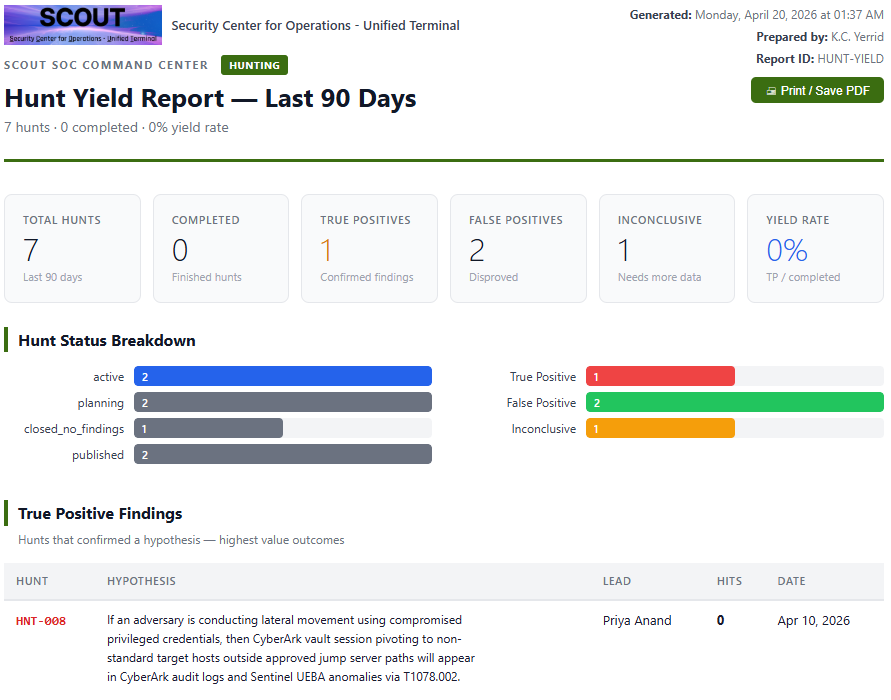
When a hunt produces a finding, PROWL guides the hunter through a structured classification process — True Positive, False Positive, or Inconclusive. True Positive findings capture the full technical detail of what was found — affected systems, observed behaviors, MITRE technique confirmed, evidence collected, and analyst assessment. From the finding record, the hunter can declare an incident directly in SHIELD with a single action — carrying the full hunt context, all collected evidence, and the complete hypothesis and methodology record forward automatically. False Positive findings are documented with the reasoning that determined them to be non-malicious — feeding directly into BLADE as tuning intelligence for the detection rules that should have caught the behavior but didn't.
Measure the Program. Improve the Program. Prove the Program.
A threat hunting program that cannot be measured cannot be improved — and cannot be defended when leadership asks whether the investment is producing results. PROWL captures the operational data that turns a collection of individual hunts into a measurable, improvable program — yield rates, coverage trends, analyst performance, intelligence utilization, and detection impact — giving hunt leads the evidence to run the program and CISOs the data to justify it.
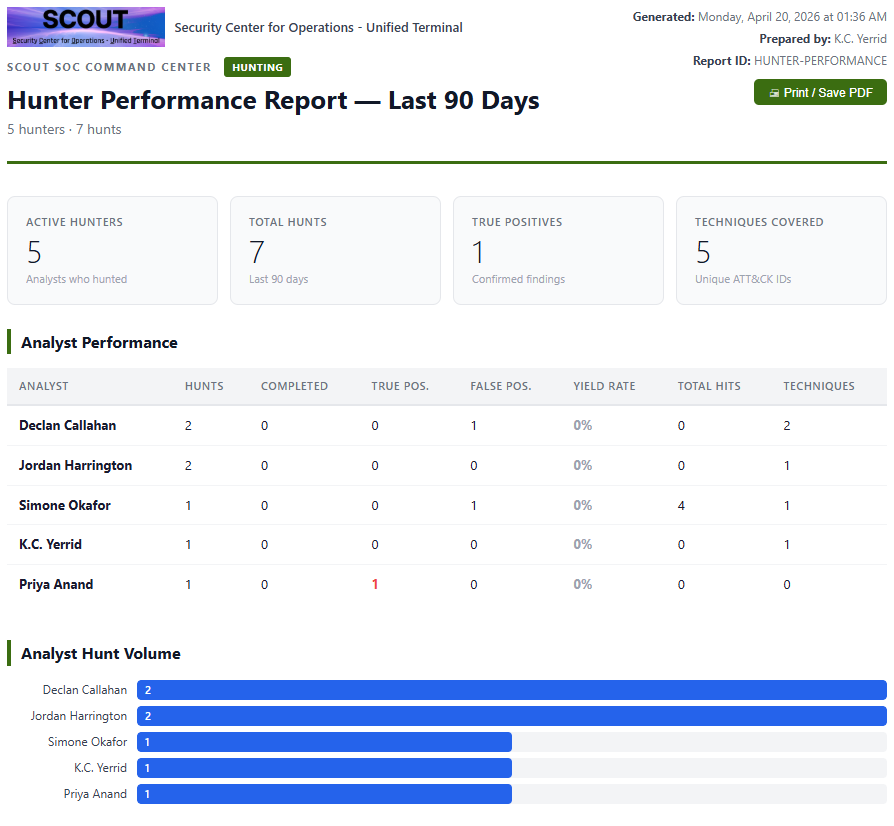
Every hunt completed in PROWL contributes to a growing analytics dataset covering the full program. Yield rate — the percentage of hunts producing True Positive findings — is tracked by analyst, by technique family, by intelligence source, and by time period. Coverage trends show which parts of the ATT&CK matrix are receiving consistent attention and which are being neglected. Analyst performance metrics surface hypothesis quality, hunt velocity, finding rate, and documentation completeness. Detection impact measures how many BLADE detection requests originated from PROWL findings and how many resulted in new or improved detection rules. The complete analytics picture is available on demand and feeds directly into SCOUT's executive reporting layer.
The Best Hunt Your Team Ever Ran Should Be the Starting Point for the Next One.
In most SOCs, threat hunting knowledge lives in the heads of the analysts who developed it — which means it leaves when they do. The hypotheses that took months to develop, the techniques that consistently produce findings, the data sources that are most reliable for specific threat types — all of it walks out the door with the hunter who discovered it, unless there is a structured platform to capture it. PROWL makes institutional knowledge a property of the program, not the individual.
Every completed hunt in PROWL — regardless of outcome — is preserved in the hunt library as a fully documented reference. Hypotheses that produced True Positive findings are tagged and surfaced as high-value starting points for future hunts. Methodologies that worked are documented in enough detail to be replicated by any analyst on the team. Data sources and queries that proved most effective are captured within the hunt record and available for reuse. Hunt templates built from the most successful historical hunts give new analysts a structured starting point rather than a blank page. The hunt library grows with every completed investigation — becoming more valuable as the program matures and more resilient to the analyst turnover that depletes institutional knowledge in every SOC.
How PROWL works
From the First Alert to the Final Record — Every Step Documented.
Intelligence Gathered
Hypothesis Developed
Hunt Prioritized
Hunt Assigned
Hunt Executed
Environment Analyzed
Finding Classified
Incident Declared (if True Positive)
Detection Gap Identified
ATT&CK Coverage Updated
Knowledge Preserved
Program Measured

Frequently Asked Questions
If your hunters are talented but your program has no structure, no coverage visibility, and no way to measure whether the investment is producing results — PROWL was built for exactly that problem. Here are the questions threat hunters, hunt leads, and security leaders ask most often about how PROWL turns individual hunting skill into a measurable, improvable program.
PROWL is SCOUT's threat hunting pillar — a structured, hypothesis-driven workspace where analysts go looking for threats that haven't triggered an alert yet. It gives hunters the methodology, the intelligence integration, the execution workflow, and the program analytics to find what alert-driven security operations miss — and turn every finding into a detection that closes the gap permanently.
Running queries in a SIEM is a technique. PROWL is a program. The difference is structure — every hunt in PROWL starts with a documented hypothesis grounded in threat intelligence, executes through a defined workflow that captures the full methodology, classifies every outcome in a structured finding record, and contributes to a cumulative coverage map and analytics dataset that measures and improves the program over time. A SIEM query produces a result. PROWL produces institutional knowledge.
A hunt hypothesis is a structured statement that defines what the hunter is looking for, why they believe it might be present, which MITRE ATT&CK technique it targets, and what data sources will be used to investigate it. PROWL guides hypothesis development using the If-Then-Via framework — if this threat actor or technique is present, then this behavior should be observable, via this data source. CIPHER surfaces relevant threat actor TTPs, active campaigns, and recent intelligence hits directly in the hypothesis workspace — giving hunters a targeted starting point grounded in real-world adversary behavior rather than intuition or generic technique libraries.
PROWL connects directly to CIPHER's entity registry and threat actor profiles. When a hunter opens a new hypothesis, CIPHER surfaces relevant threat actors, their known TTPs, their active campaigns, and any recent RSS intelligence hits that suggest increased activity. Threat actor TTPs map directly to MITRE ATT&CK techniques in the hunt hypothesis — giving the hunter a pre-populated starting point that reflects the actual threat landscape. Hunt findings that confirm a known actor's TTP feed back into CIPHER — enriching the entity record with environmental evidence and strengthening the intelligence picture for every future hunt.
PROWL supports five hunt workflow stages — Planning, Active, Findings Review, Published, and No Findings. Each stage has defined inputs and outputs that ensure every hunt produces a complete record regardless of outcome. Planning captures the hypothesis and methodology before execution begins. Active tracks the real-time investigation as it progresses. Findings Review documents and classifies the outcome. Published marks True Positive findings that have been escalated and documented. No Findings marks hunts that found no evidence of the targeted behavior — which is itself a valuable data point for coverage tracking.
Every action taken during a hunt is documented within the hunt record in real time — queries run, data sources accessed, observations made, threads followed and abandoned, and decisions taken at each stage of the investigation. Every note is timestamped and attributed to the analyst who added it. The hunt record builds itself as the work progresses — so any analyst who picks up a hunt in progress starts exactly where the previous analyst left off, and any analyst who reviews a completed hunt can replicate the methodology without asking.
Every hunt in PROWL concludes with a structured classification — True Positive, False Positive, or Inconclusive. True Positive findings capture the full technical detail of what was confirmed — affected systems, observed behaviors, timeline of activity, MITRE technique validated, evidence collected, and analyst confidence assessment. False Positive findings document the reasoning that determined the behavior to be non-malicious. Inconclusive findings capture what was investigated, what was found, and what additional data or access would be needed to reach a definitive conclusion.
A True Positive finding triggers two simultaneous actions. First, the hunter declares an incident directly in SHIELD from within the PROWL finding record — carrying the full hypothesis, all collected evidence, the complete hunt methodology, the confirmed MITRE technique, and the affected systems forward automatically. The response team starts with complete context rather than a blank incident record. Second, PROWL routes a detection engineering request to BLADE — specifying the technique confirmed, the data source that revealed it, and the behavioral indicators that distinguished malicious from benign activity. The finding closes the detection gap that allowed the threat to go undetected.
False Positive findings are documented with the full reasoning that determined the behavior to be non-malicious — preserving the analysis that future analysts won't need to repeat. The finding routes to BLADE as tuning intelligence — specifying the behavior that generated noise and the characteristics that distinguished it from genuine threat activity. False Positives are not wasted hunts. They are documented contributions to the detection engineering program that prevent the same investigation from happening twice.
Every hypothesis and every completed hunt in PROWL carries a MITRE ATT&CK tactic and technique mapping. As hunts are completed, PROWL builds a cumulative coverage map — a live picture of which techniques have been hunted, how recently, how many times, and with what outcome. Techniques that have never been hunted surface as explicit gaps. Techniques that are known TTPs of threat actors in CIPHER are flagged as priority coverage targets. The coverage map connects directly to BLADE — techniques with confirmed findings but no detection rule generate automatic detection engineering requests.
PROWL captures a comprehensive analytics dataset covering the full program — yield rate by analyst and technique family, ATT&CK coverage trends, hypothesis quality scores, hunt velocity, detection impact from BLADE, and intelligence utilization rates. The hunt lead sees the operational picture for program management. The CISO sees the strategic picture for board reporting and investment justification. Both views feed directly into SCOUT's executive reporting layer — turning the work hunters do every day into the evidence leadership needs to demonstrate program maturity without requiring a separate reporting effort to produce it.
Every completed hunt is recorded in the PROWL coverage map with the date, the analyst, and the outcome. When a new hypothesis targets a technique that has recently been hunted, PROWL surfaces the previous hunt record — showing the methodology that was used, the outcome that was produced, and whether the technique has been covered by a detection rule since the last hunt. Hypothesis prioritization deprioritizes recently covered techniques in favor of gaps — ensuring the program expands its coverage rather than circling familiar territory.
Every completed hunt enters the PROWL hunt library — fully documented, fully searchable, and fully available to every analyst on the team. Hunts that produced True Positive findings are tagged as high-value references and surfaced as starting points for future hypothesis development. The methodology, the queries, the data sources, and the indicators that proved most useful are preserved in enough detail to be replicated by any analyst without asking the one who originally ran the hunt. When an experienced hunter leaves the team, everything they documented stays — the program retains the knowledge even when it loses the person.
Yes. Hunt records in PROWL are shared workspaces — every team member can view, contribute to, and track any active hunt in real time. Notes added by one analyst are immediately visible to all others. For complex hunts requiring multiple data source specialists or extended investigation periods, multiple analysts can contribute to the same hunt record concurrently without overwriting each other's work. The full contribution history — every note, every query, every observation, attributed to the analyst who added it — is preserved throughout.
PROWL sits at the proactive edge of the SCOUT operational chain. It draws intelligence from CIPHER to generate targeted hypotheses, escalates True Positive findings directly to SHIELD for incident response, routes detection gaps and tuning intelligence to BLADE for detection engineering improvement, and contributes ATT&CK coverage data to TIME for threat model refinement. Every hunt PROWL completes makes the intelligence, response, detection, and modeling capabilities of the full SCOUT platform stronger — closing the loop between proactive hunting and the reactive and strategic functions that depend on what hunting discovers.
PROWL feeds a comprehensive set of program reports into SCOUT's reporting layer — hunt yield rate by time period and technique family, ATT&CK coverage expansion trend, analyst performance and productivity metrics, detection engineering impact from hunting findings, intelligence utilization rates by source, and hypothesis quality scores. Reports are available on demand or on a scheduled basis and feed directly into SCOUT's executive dashboard — giving CISOs the evidence to demonstrate hunting program maturity, justify continued investment, and brief the board on the proactive security posture the program represents.
Discover the Impact of SCOUT Through Video or a Live Demo
Every SOC invests in detection tools. The best ones also invest in the capability that finds what those tools miss.
Sophisticated attackers don’t trip detection rules — they study them, avoid them, and operate patiently in the gaps between them. They count on the fact that most security operations teams are too busy responding to alerts to go looking for the threats that haven’t triggered one yet. That patience is their most valuable weapon. PROWL takes it away.
Structured, hypothesis-driven threat hunting — grounded in real threat intelligence, executed through a documented methodology, and measured against the MITRE ATT&CK framework — is the capability that changes the equation. Not because it replaces alert-driven operations, but because it finds what alert-driven operations were never designed to find. The lateral movement that happened before the detection rule existed. The persistence mechanism that doesn’t match any known signature. The credential abuse that looks exactly like legitimate access until a hunter knows to look for the pattern.
PROWL gives your team the structure to hunt with purpose, the intelligence integration to hunt where the actual risk is, and the pipeline to ensure that every confirmed finding closes a detection gap permanently. Every hunt makes the program smarter. Every finding makes the environment safer. Every True Positive that routes to BLADE means the same threat will never go undetected again.
If your SOC is ready to stop waiting for the alert that might never come and start building the proactive hunting capability that finds threats on your terms — PROWL is where that starts.
SCOUT is available now. Watch the full platform demonstration and see PROWL in action — from hypothesis development to hunt execution, finding classification to incident escalation, ATT&CK coverage mapping to detection engineering impact. One hour. Seven pillars. Everything your SOC has been missing.






Operate Ahead of the Threat.
SCOUT is a unified SOC platform with seven purpose-built pillars — covering every workflow from alert triage to detection engineering — built by analysts, for analysts, at the speed modern threats demand.
Rated 4.9 of 5

SCOUT © All rights reserved
