
When the Alarm Sounds, SHIELD Answers.
Incidents don't wait for your team to get organized. They move fast, they spread laterally, and they exploit every second of hesitation and every gap in coordination. SHIELD moves faster — a structured incident response platform that takes the chaos of a confirmed threat and replaces it with a coordinated, documented, accountable response from declaration to closure.



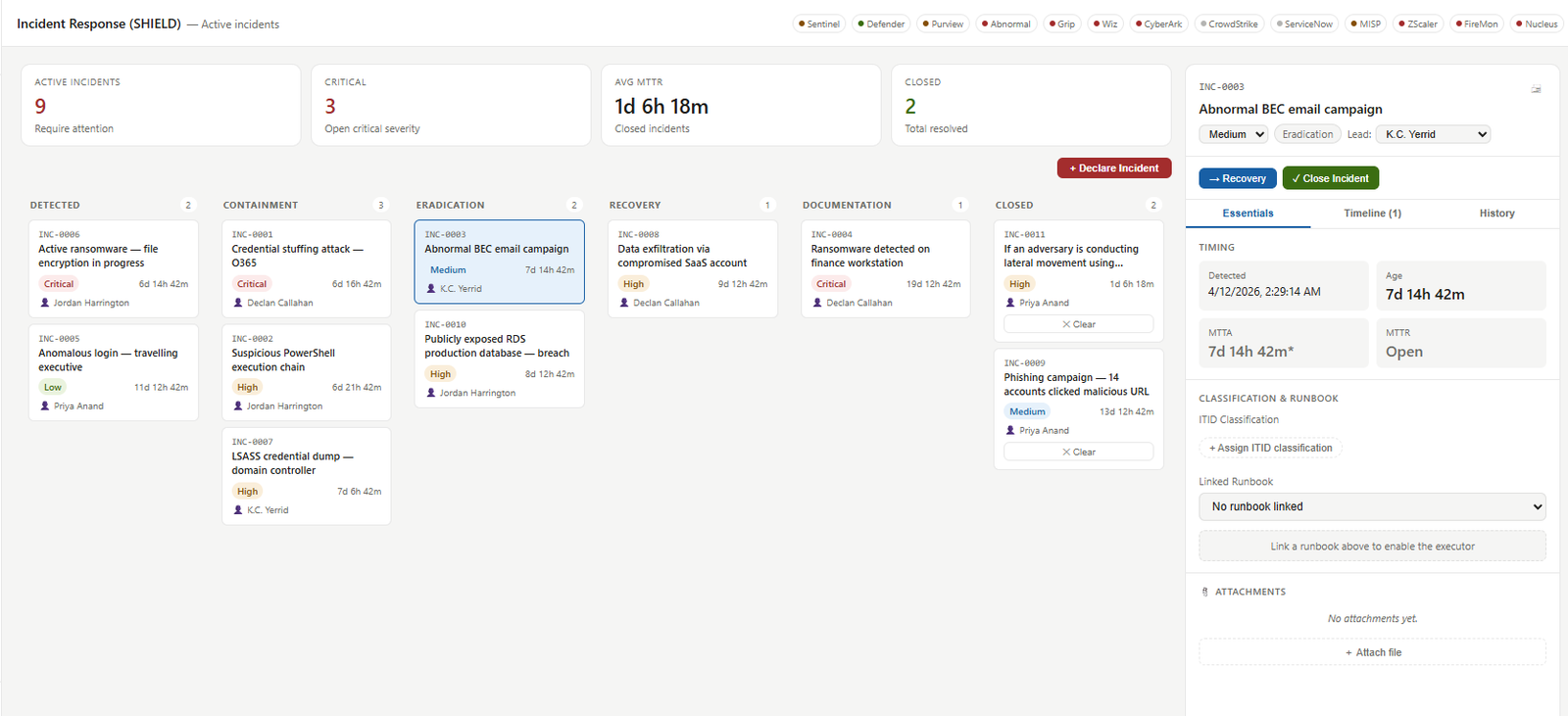
Pillar Features — Problems SHIELD solves
The Uncoordinated Response
The Undeclared Incident
The Missing Timeline
The Undocumented Decision
The Leadership Visibility Gap
The Severity Miscalculation
The Containment Gap
The Runbook Nobody Followed
The Post-Incident Review That Never Happened
The Regulatory Exposure
The Metrics That Don't Exist
The Context Lost in Escalation
What SHIELD delivers
Every Capability. Every Workflow. Every Detail of How SHIELD Runs Your Incident Response.
The Moment It's Real, SHIELD Takes Control.
The difference between a contained incident and a catastrophic breach is often measured in the minutes between recognition and declaration. SHIELD eliminates the hesitation — a structured declaration process that defines severity the moment an incident is confirmed, mobilizes the right resources immediately, and starts the response clock before the threat has time to move.
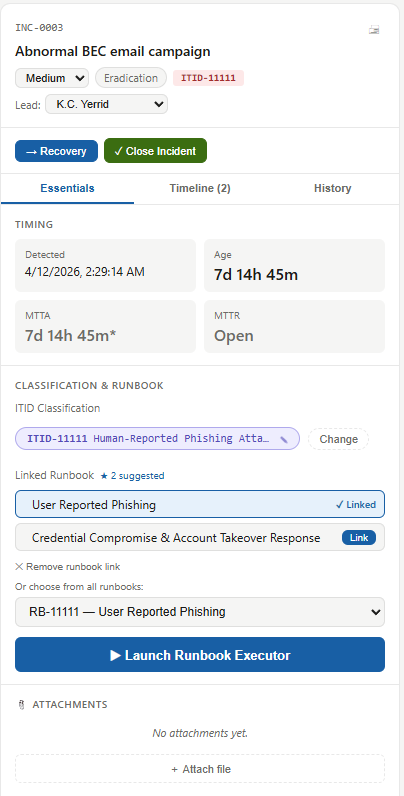
When a case in ANCHOR meets the incident threshold, it promotes to SHIELD with a single action — carrying the full investigative context, all case notes, all evidence attachments, and the complete alert history forward automatically. At declaration, the analyst assigns a severity tier — P1 through P4 — based on defined criteria covering blast radius, data exposure risk, business impact, and threat actor confidence. Severity determines the response template applied, the escalation path triggered, and the SLA thresholds that govern the response from that moment forward. Every declaration is timestamped, attributed, and recorded as the official start of the incident record.
Every Responder Knows Their Role. Every Action Has an Owner.
Incident response fails when people don't know what everyone else is doing. Actions get duplicated. Gaps get missed. The response fragments into a collection of individual efforts that never quite add up to a coordinated defense. SHIELD replaces that fragmentation with a shared, real-time response workspace where every responder sees the same picture, every action has an owner, and nothing happens without a record.
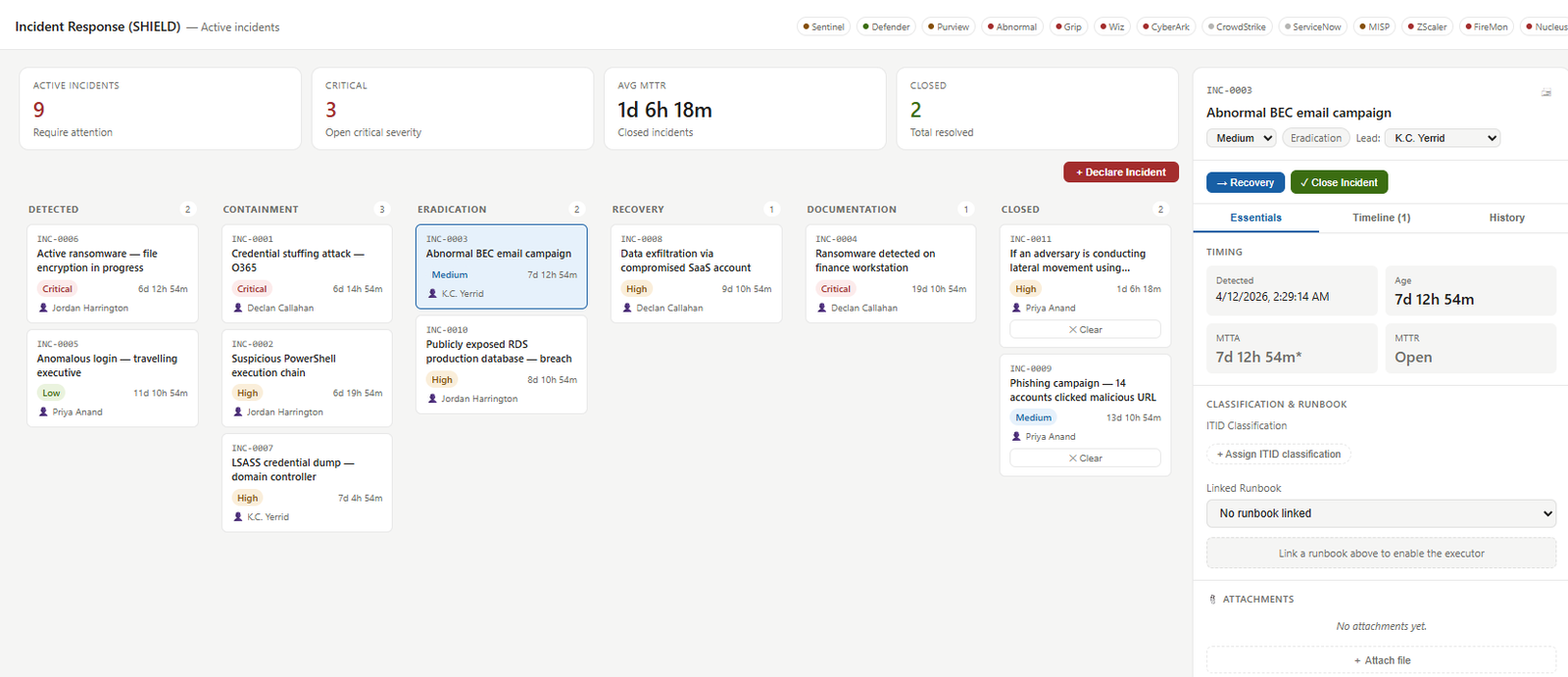
Every declared incident in SHIELD has a designated Incident Commander — the analyst or manager responsible for coordinating the overall response. Supporting analysts are assigned to specific workstreams — containment, eradication, communications, evidence collection — with their assignments visible to the full team in real time. Every action taken during the response is logged against the analyst who took it, with timestamp and outcome recorded. The response workspace shows every open task, every completed action, and every pending decision in a single view — giving the Incident Commander the situational awareness to direct the response without having to chase status updates from every member of the team.
Every Action. Every Decision. Every Moment. On the Record.
The incident timeline is the single most important artifact a SOC produces. It is the evidence regulators rely on, the record post-incident reviews are built from, and the documentation that determines whether a response was defensible or not. SHIELD builds that timeline automatically — every action, every decision, and every development recorded in real time as the response unfolds, not reconstructed from memory after it ends.
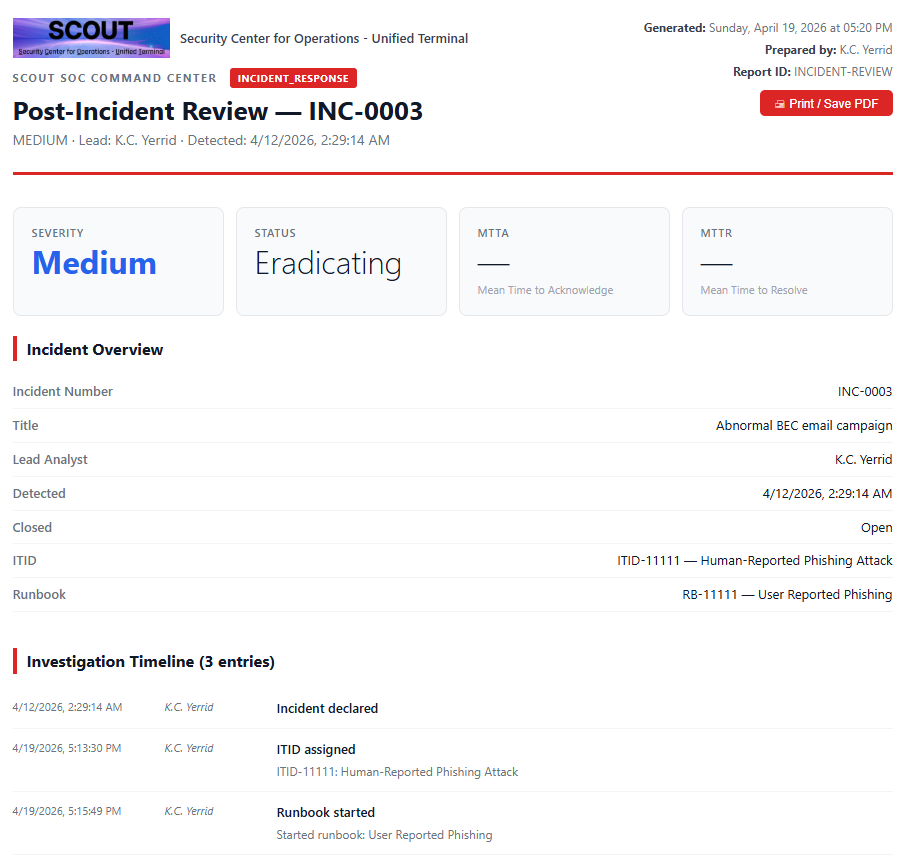
SHIELD maintains a live incident timeline that captures every significant event from declaration to closure — containment actions, analyst assignments, escalations, evidence collection, stakeholder notifications, system changes, and resolution milestones. Every entry is timestamped to the second and attributed to the analyst or system that generated it. Evidence attaches directly to the incident record — forensic images, memory captures, log exports, network captures, and supporting documentation — organized chronologically and searchable by type, analyst, and date range. The timeline is visible to every authorized team member in real time and exports in formats suitable for regulatory submission, legal proceedings, and executive briefings.
Contained Here Means Contained Everywhere. SHIELD Makes Sure of It.
Partial containment is the most dangerous kind — it creates the illusion of control while the threat continues to operate in the gaps. SHIELD tracks every containment and eradication action across every affected system, every impacted account, and every compromised resource — so the team knows exactly what has been addressed and what still needs attention, without relying on anyone's memory to keep track.
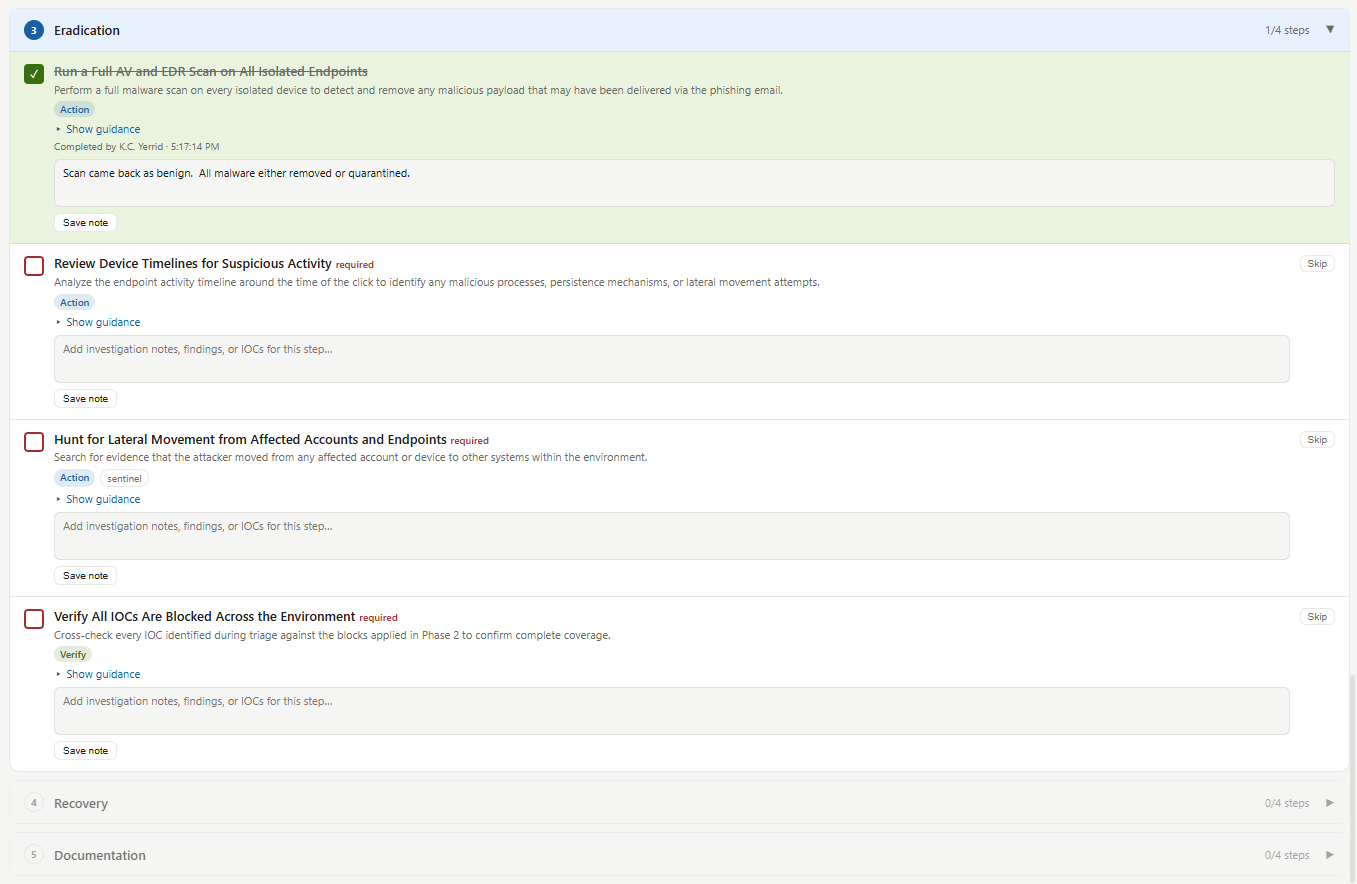
SHIELD organizes the containment and eradication phase around a structured checklist tied to the incident type and severity. Each containment action — system isolation, account suspension, network segmentation, credential rotation, malware removal — is tracked as a discrete task with an assigned analyst, a target system or resource, a completion status, and a verification step. Completed actions are marked and visible to the full team. Outstanding actions surface as open items in the response workspace. The Incident Commander sees the overall containment picture in real time — what's done, what's in progress, and what hasn't been started yet — without having to ask.
The Right Runbook. At the Right Moment. Followed Step by Step.
Runbooks exist for a reason — to ensure that the right steps are taken in the right order under pressure, when the cost of improvisation is highest. But a runbook that sits in a shared drive or a wiki is a document, not a tool. SHIELD surfaces the right runbook the moment an incident is declared and tracks every step of its execution in real time — turning documented procedures into verified actions.
When an incident is declared in SHIELD, the platform automatically surfaces the runbook associated with the incident type and severity. The runbook opens within the incident workspace — step by step, phase by phase — with each action available to be marked complete, skipped with a documented reason, or flagged for escalation. Every step completion is attributed to the analyst who performed it and timestamped. Required steps cannot be skipped without a recorded justification. Optional steps can be bypassed with a single action. The full execution record — every step, every analyst, every timestamp, every deviation — becomes part of the incident record and feeds directly into post-incident review and compliance reporting.
Leadership Gets Answers Without Pulling Analysts Off the Response.
During a major incident, the demand for status updates from leadership, legal, compliance, and communications teams is constant and relentless. Every update request pulls an analyst away from the response for minutes that the threat is using to move. SHIELD manages stakeholder communication from within the incident workspace — so leadership stays informed without the response team stopping to inform them.
SHIELD maintains a dedicated communications log within every incident record — a structured record of every stakeholder notification, status update, and external communication associated with the incident. Notifications are templated by severity and incident type, pre-populated with the current incident status, and sent directly from within the platform. The communications log captures who was notified, what they were told, when the notification was sent, and who sent it — creating a complete stakeholder communication record that satisfies regulatory notification requirements and supports post-incident review. For regulatory notification obligations with defined timeframes, SHIELD tracks the notification deadline and surfaces a warning before it is missed.
The Incident Closes. The Learning Begins.
The post-incident review is where a SOC either improves or repeats itself. When it happens consistently, with complete information, and produces documented findings with assigned owners, it drives program maturity. When it gets skipped — because the team is already on the next incident, because the documentation doesn't support it, or because there's no structured process to conduct it — the same mistakes compound over time. SHIELD makes the post-incident review a natural conclusion to every incident rather than an optional exercise that rarely happens.
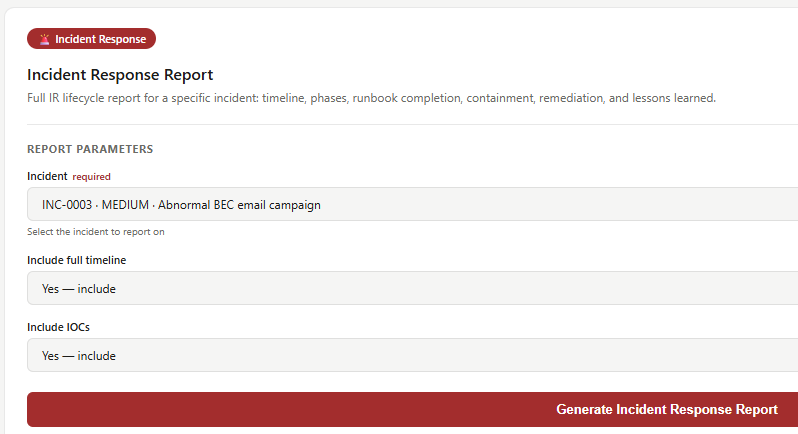
When an incident moves to closure in SHIELD, the platform initiates a structured post-incident review workflow. The review captures the complete incident timeline, every containment and eradication action, the full runbook execution record, SLA performance against declared severity, stakeholder communications, and a structured findings section covering what happened, what worked, what failed, and what needs to change. Each finding is assigned an owner and a remediation deadline — feeding directly into BLADE for detection engineering improvements, into ANCHOR for process updates, and into TIME for threat model refinement. The completed review generates a Post-Incident Report that exports in formats suitable for executive briefing, regulatory submission, and board reporting.
How SHIELD works
From Declaration to Post-Incident Review — Every Step Coordinated, Documented, and Defensible.
Threat Confirmed
Incident Declared
Response Team Mobilized
Runbook Activated
Containment Executed
Timeline Built in Real Time
Stakeholders Informed
Eradication Verified
Recovery Managed
Incident Closed
Post-Incident Review Conducted
Post-Incident Report Generated
Frequently Asked Questions
If you've ever lost investigation context between shifts, missed an SLA because nobody saw it coming, or struggled to produce case documentation for an auditor — ANCHOR was built for exactly those problems. Here are the questions analysts and security leaders ask most often about how ANCHOR solves them.
SHIELD is SCOUT's incident response pillar — the structured workspace where every confirmed threat is managed from the moment of declaration through containment, eradication, recovery, and post-incident review. It gives response teams a coordinated, documented, and accountable environment where every action is recorded, every decision is attributed, and every incident produces a complete record that survives long after the response ends.
When a case in ANCHOR meets the incident threshold — confirmed breach, active threat actor, spreading compromise, or significant business impact — the analyst promotes it to SHIELD with a single action. The full case record carries forward automatically — every note, every piece of evidence, every linked alert, and the complete investigative history. At declaration, severity is assessed against defined criteria and a tier is assigned — P1 through P4 — which determines the response template, escalation path, and SLA thresholds that govern the response from that moment forward.
SHIELD supports four severity tiers — P1 through P4. P1 represents a critical incident with active threat actor presence, confirmed data exfiltration, or significant business impact requiring immediate executive involvement. P2 represents a high severity incident with confirmed compromise and contained but unresolved threat activity. P3 represents a medium severity incident with suspected compromise requiring investigation and structured response. P4 represents a low severity incident with minimal business impact and a clear resolution path. Each tier carries defined escalation paths, notification requirements, SLA thresholds, and response templates.
Everything the case built in ANCHOR carries forward automatically — every investigation note, every evidence attachment, every linked alert, the complete status history, the full analyst assignment record, and the SLA compliance data from the case phase. The incident record in SHIELD begins with the complete investigative context already in place. The response team starts fully informed rather than reconstructing what the investigation team already knew.
Every declared incident in SHIELD has a designated Incident Commander responsible for overseeing the full response. Supporting analysts are assigned to specific workstreams — containment, eradication, communications, and evidence collection — with their assignments visible to the full team in real time. Every action is logged against the analyst who took it with timestamp and outcome recorded. The response workspace shows every open task, every completed action, and every pending decision in a single view, giving the Incident Commander real-time situational awareness without having to chase status updates from every team member.
When an incident is declared, SHIELD automatically surfaces the runbook associated with the incident type and severity. The runbook opens within the incident workspace — phase by phase, step by step — with each action tracked to completion and timestamped as it is verified. Required steps cannot be bypassed without a recorded justification. Optional steps can be skipped with a single action. The full execution record — every step, every analyst, every timestamp, every deviation — becomes part of the incident record and feeds directly into post-incident review and compliance reporting.
SHIELD builds the incident timeline automatically as the response progresses — every action, every decision, and every development recorded with timestamp and analyst attribution the moment it happens. There is no separate documentation step and no reconstruction after the fact. The timeline that exists at closure is the timeline that was built during the response — accurate to the second and complete by design. It exports in formats suitable for regulatory submission, legal proceedings, post-incident review, and executive briefing.
Evidence attaches directly to the incident record as it is collected — forensic images, memory captures, log exports, network captures, screenshots, and supporting documents. Every attachment is timestamped, attributed to the analyst who added it, and organized chronologically within the incident timeline. Evidence is searchable by type, analyst, and date range. It remains permanently attached to the incident record — it cannot be separated from the investigation it belongs to — and is available for export in formats suitable for legal and regulatory use.
SHIELD maintains a dedicated communications log within every incident record — capturing every stakeholder notification, status update, and external communication associated with the incident. Notifications are templated by severity and incident type, pre-populated with current incident status, and sent directly from within the platform. The log captures who was notified, what they were told, when the notification was sent, and who sent it. Regulatory notification deadlines triggered by the incident are tracked and surfaced before they are missed, ensuring compliance obligations are met without requiring the response team to manage them manually.
SHIELD organizes the containment and eradication phase around a structured checklist tied to the incident type and severity. Each action — system isolation, account suspension, network segmentation, credential rotation, malware removal — is tracked as a discrete task with an assigned analyst, a target system or resource, a completion status, and a verification step. The Incident Commander sees the real-time containment picture — what is done, what is in progress, and what still needs attention — without having to ask. The response does not move to recovery until every containment and eradication action is documented as complete and verified.
Closure requires a documented disposition — what happened, what was done, and why the incident is considered resolved. Every metric associated with the incident — time to declare, time to contain, time to eradicate, time to recover, and total incident duration — is captured and fed into SCOUT's reporting layer. The SLA record is finalized. The incident record is sealed and preserved. SHIELD then initiates the post-incident review workflow automatically, ensuring that the learning phase follows the response phase without requiring a separate decision to make it happen.
SHIELD initiates a structured post-incident review workflow at incident closure — a defined process that examines the complete incident record and produces documented findings covering what happened, what worked, what failed, and what needs to change. Every finding is assigned an owner and a remediation deadline. Detection gaps feed into BLADE. Process failures feed into ANCHOR. Threat model updates feed into TIME. The review produces a Post-Incident Report that exports in formats suitable for executive briefing, regulatory submission, and board reporting.
SHIELD captures a comprehensive set of incident metrics automatically — mean time to declare, mean time to contain, mean time to eradicate, mean time to recover, total incident duration, SLA compliance by severity tier, escalation rates by incident type, runbook adherence rates, and post-incident review completion rates. These metrics feed directly into SCOUT's reporting layer, producing the operational performance data SOC managers need to run the program and the evidence CISOs need to brief the board — without requiring a separate reporting project to produce them.
SHIELD sits at the center of the SCOUT response chain. It receives promoted cases from ANCHOR with full investigative context, surfaces relevant threat intelligence from CIPHER to inform response decisions, incorporates threat model context from TIME to understand blast radius and lateral movement risk, links hunt findings from PROWL that contributed to detection, and feeds post-incident findings into BLADE for detection engineering improvements. Every incident SHIELD processes makes the detection, hunting, and modeling capabilities of the full SCOUT platform stronger.
SHIELD supports regulatory compliance in three ways. First, every action taken during an incident is recorded in an immutable audit log with timestamp and attribution — producing the documented evidence regulators require without additional effort from the response team. Second, regulatory notification deadlines triggered by the incident are tracked within the platform and surfaced before they are missed — ensuring compliance obligations are met under the pressure of an active response. Third, the Post-Incident Report generated at closure exports in formats suitable for regulatory submission — providing the complete, formatted documentation that demonstrates the incident was handled in accordance with applicable requirements.
Yes. SHIELD manages every active incident in parallel — each with its own response workspace, its own timeline, its own team assignments, its own runbook execution record, and its own SLA clock. The manager view surfaces all active incidents simultaneously — by severity, by phase, and by SLA health — giving the SOC lead the situational awareness to allocate resources across multiple concurrent responses without losing visibility into any of them. Each incident remains fully isolated in its own record while remaining visible in the aggregate view that leadership needs.
Discover the Impact of SCOUT Through Video or a Live Demo
Security Operations Centers have never had a shortage of incident response plans. What they’ve always lacked is a single, structured place to execute them under pressure. SHIELD was built to solve that problem — not by replacing the judgment of your analysts, but by giving it the coordination, the documentation, and the accountability it needs to perform at its best when the stakes are at their highest.
When every response action flows through one structured workspace, something changes. Analysts stop managing chaos and start managing outcomes. Responses move faster because context is already there. Containment is complete because every action is tracked and verified. And nothing falls through the cracks between responders, between shifts, or between the case team that built the investigation and the incident team that has to act on it.
SHIELD is the response layer SCOUT was built around — and it is the capability every high-performing SOC needs when a confirmed threat demands a coordinated, defensible answer. If your team is ready to stop improvising under pressure and start responding with the structure that separates a contained incident from a catastrophic one, SHIELD is where that starts.
SCOUT is available now. Watch the full platform demonstration and see SHIELD in action — from incident declaration to post-incident review, runbook execution to stakeholder communication, containment tracking to the final compliance record. One hour. Seven pillars. Everything your SOC has been missing.






Operate Ahead of the Threat.
SCOUT is a unified SOC platform with seven purpose-built pillars — covering every workflow from alert triage to detection engineering — built by analysts, for analysts, at the speed modern threats demand.
Rated 4.9 of 5
SCOUT © All rights reserved
