




Image link

Every Investigation. Every Detail. Nothing Lost.

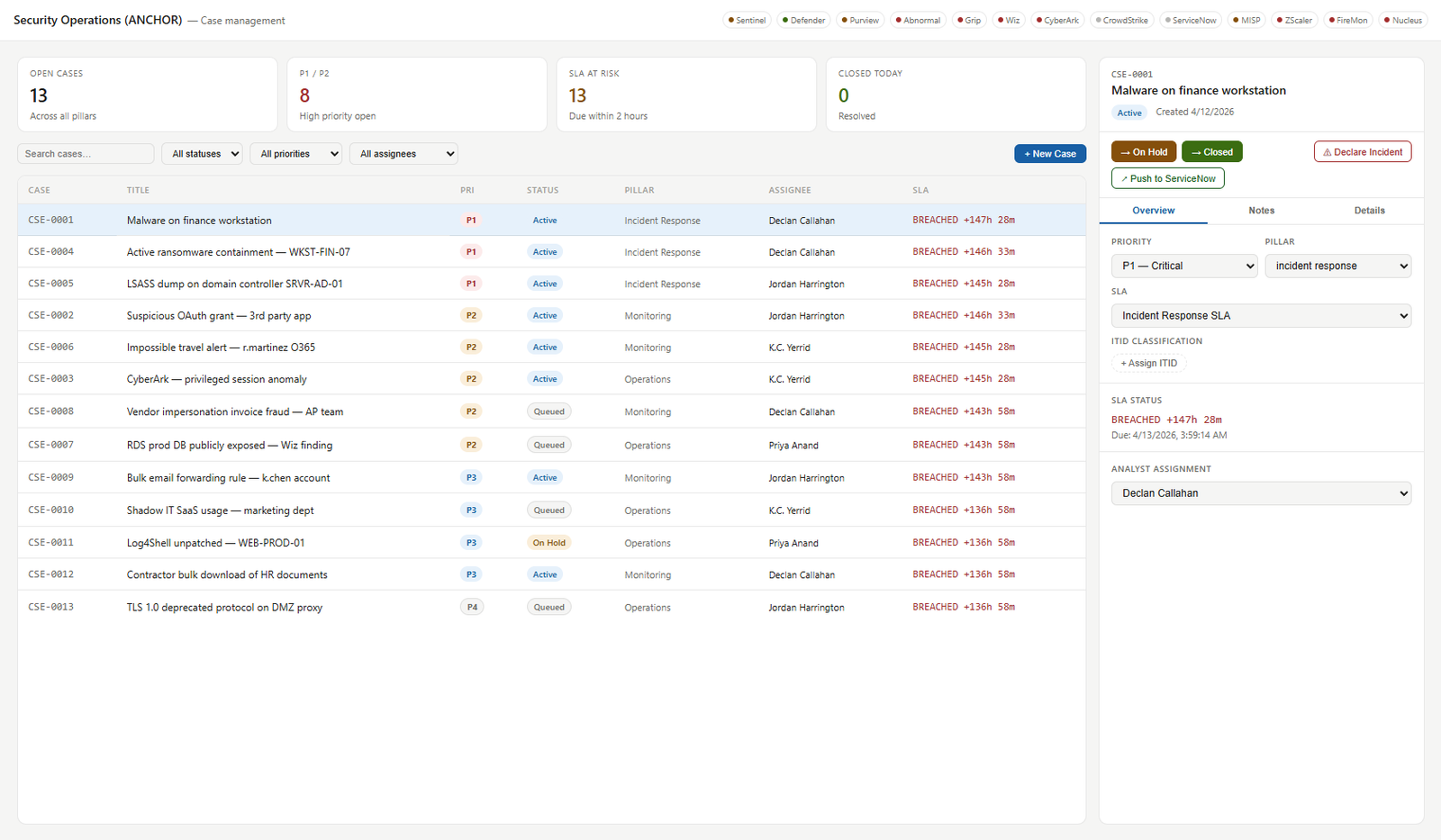
Cases without structure become investigations without answers. ANCHOR brings the structure — a persistent, connected case workspace where nothing gets lost between analysts, between shifts, or between tools. Every thread stays attached. Every case stays accountable.

Image link

Pillar Features — Problems ANCHOR solves

1
The Invisible Handoff
The analyst who picks up my case has no idea what I already know.
2
Evidence Without a Home
Our evidence lives in six places and none of them are the case.
3
The Decision Nobody Can Explain
We can't explain why we closed that case the way we did.
4
The Parallel Investigation
Two analysts worked the same threat and never knew it.
5
The Invisible Workload
I have no idea who is buried and who has capacity right now.
6
The Breach Nobody Saw Coming
We find out about SLA breaches after they've already happened.
7
The Knowledge That Left With Them
When a good analyst leaves, everything they knew leaves with them.
8
The Reconstruction Problem
Our auditor asked for case documentation and we had to reconstruct it.

What ANCHOR delivers

No more lost context. No more missed connections. No more excuses.

Every Case Has a Beginning. ANCHOR Makes Sure It Has an End.

A case without structure is just a collection of notes with no destination. ANCHOR gives every investigation a defined lifecycle — from the moment it opens to the moment it closes — with every stage documented, every transition recorded, and every outcome preserved for the team that comes after.

Cases in ANCHOR move through five defined stages — Open, In Progress, Pending, Escalated, and Closed. Each stage transition is timestamped and attributed to the analyst who made it. No case can close without a documented disposition. No escalation happens without a recorded reason. Every status change builds the audit trail automatically, as a byproduct of how analysts work — not as additional documentation burden on top of it.

Regulators want documented evidence that investigations were conducted thoroughly and decisions were made for articulable reasons. Post-incident reviews need a complete timeline of what happened and when. Leadership wants confidence that nothing is sitting unworked in a queue nobody is watching. ANCHOR delivers all three — not as reports generated after the fact, but as a natural output of the investigative process itself.

The Context Your Next Analyst Needs Is Already There.

The most expensive moment in any investigation is the one where an analyst has to reconstruct what the previous analyst already knew. ANCHOR eliminates that moment — every note timestamped, every piece of evidence attached, every observation documented and waiting for whoever needs it next.

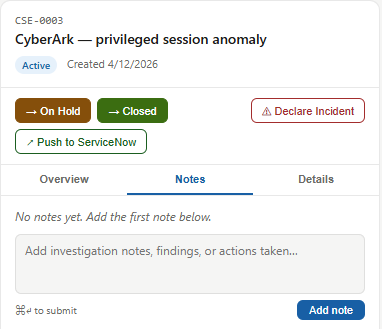
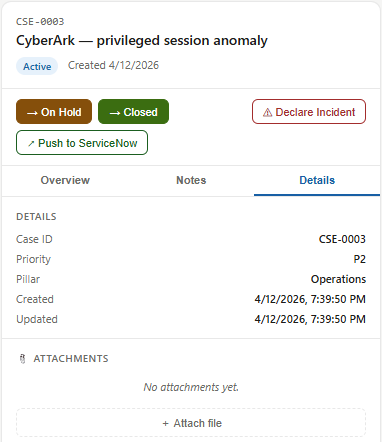
Analysts add timestamped, attributed notes directly to the case as the investigation develops — observations, decisions, dead ends, and confirmed findings. Evidence attaches directly to the case record — screenshots, log exports, memory captures, network captures, and supporting documents — organized by type and searchable by content. Every note and every attachment carries the analyst's name and the exact time it was added, creating a living investigation record that builds itself as work progresses.

When a case changes hands — between analysts, between shifts, or between teams — the receiving analyst starts with full context rather than a blank slate. When an auditor asks what evidence supported a decision, the answer is a single click away. When a post-incident review needs a complete investigation timeline, it already exists. The work of documentation happens during the investigation, not after it.

No Investigation Exists in Isolation. ANCHOR Makes Sure Nothing Is Missed.

Threats don't announce themselves through a single alert. They leave traces across multiple tools, multiple timeframes, and multiple analysts — each piece looking like noise until the connections are made. ANCHOR connects the dots — linking alerts to cases, cases to incidents, and related investigations to each other — so the full picture emerges before the post-incident review.

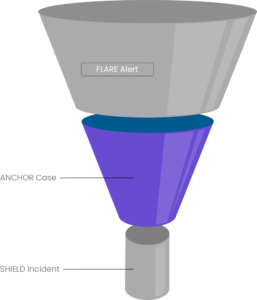
Every case in ANCHOR carries direct links to the alerts that triggered it, the incidents it escalates into, and any related cases the team has identified. Alert metadata — source tool, detected entity, MITRE ATT&CK technique, severity, and raw signal — carries forward automatically when a case is opened from an alert. When a case meets the incident threshold, it promotes directly to SHIELD with its full investigative history intact. Related cases surface as suggestions based on shared entities, techniques, and timeframes — giving analysts the connections they need to see before they know to look for them.

The difference between a contained incident and a catastrophic breach is often a connection that was made too late — or never made at all. When alerts, cases, and incidents are siloed in separate systems, those connections depend entirely on individual analysts having the right context at the right moment. ANCHOR makes the connections structural rather than incidental — visible to every analyst, on every case, from the moment it opens.

Every Case Has a Clock. ANCHOR Makes Sure Everyone Knows It.

SLA breaches don't happen because analysts don't care about deadlines. They happen because nobody knew the deadline was approaching until it had already passed. ANCHOR puts the clock on every case from the moment it opens — visible to the analyst working it, the manager overseeing it, and the reporting layer that captures it.

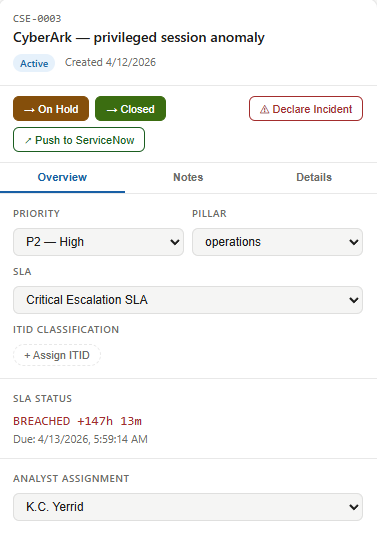
Every case in ANCHOR carries an SLA threshold determined by its priority tier — P1 through P4 — with configurable targets for time-to-acknowledge and time-to-close. The SLA clock starts at case creation and runs continuously. Cases approaching their threshold surface in the analyst's workspace with a visual warning. Cases that breach their threshold are flagged immediately in the manager view and recorded in the SLA compliance log. Every outcome — met, breached, and by how much — is captured automatically for reporting and compliance evidence.

In financial services and other regulated industries, SLA compliance isn't just an operational metric — it's a compliance requirement. Demonstrating that your SOC acknowledges and resolves incidents within defined timeframes requires documented evidence, not reconstructed estimates. ANCHOR produces that evidence automatically, as cases are worked, without requiring analysts to generate separate reports or managers to chase status updates.

Balance the Team Before the Team Breaks.

Analyst burnout rarely announces itself. It accumulates quietly — in the case queue that keeps growing, in the SLAs that keep slipping, in the analyst who stops asking questions because they've stopped having the capacity to ask them. ANCHOR gives managers the visibility to intervene before the accumulation becomes a crisis.

Every case in ANCHOR is assigned to a named analyst with a defined priority and SLA. The manager view surfaces a real-time workload picture — open cases by analyst, average case age by analyst, SLA health by analyst, and escalation rates by analyst. Cases can be reassigned with a single action, with the full history of the previous assignment preserved. New cases can be assigned manually or distributed based on current workload — giving managers the data to make balanced distribution decisions rather than defaulting to whoever spoke up last at standup.

Workload visibility is the difference between managing a team and managing a crisis. When a manager can see in real time that one analyst is carrying three times the load of the rest of the team, they can intervene before the cracks show in case quality, SLA compliance, or analyst wellness. ANCHOR connects directly to SCOUT's wellness tracking — so the manager who sees a heavy workload can also see whether the analyst carrying it is showing signs of burnout.

The Audit Trail Builds Itself. The Report Writes Itself.

Compliance evidence shouldn't require a separate project. When investigations are conducted in a structured, documented platform, the evidence regulators and auditors need is a natural byproduct of how analysts work every day. ANCHOR makes that true — every action documented, every decision attributed, every outcome preserved.

Every interaction with a case in ANCHOR — note additions, status changes, evidence attachments, assignments, escalations, and closures — is timestamped, attributed, and stored in an immutable audit log. Case data feeds directly into SCOUT's reporting layer, producing SLA compliance reports, investigation quality metrics, analyst performance data, and case volume trends without requiring manual data collection or retrospective reconstruction. Reports can be generated on demand or scheduled for regular delivery to SOC leadership and compliance stakeholders.

When a regulator asks for evidence of your incident management process, the answer should be a report generated in seconds — not a week-long effort to reconstruct timelines from memory and chat logs. When a board asks how many P1 incidents were handled last quarter and what the average resolution time was, the answer should be a number with a source — not an estimate with a caveat. ANCHOR makes both possible without adding a single minute of additional work to the analysts who are already doing the work.

How ANCHOR works

From the First Alert to the Final Record — Every Step Documented.

1
Alert Received
Every investigation starts with a signal. FLARE promotes the alert to ANCHOR with full context already attached — source tool, detected entity, severity, and MITRE mapping — so the analyst starts informed, not from scratch.
2
Case Created
A structured case record opens immediately, priority is assigned, and the SLA clock starts. The case enters the team's shared workspace where every member can see it, contribute to it, and track it in real time.
3
Investigation Builds
Analysts add timestamped notes, attach evidence, and link related alerts as the investigation develops. Every action enriches the case record automatically — building the context the next analyst will need before they know they need it.
4
Team Collaborates
Every note is visible to the full team in real time and every assignment is transferable with full history preserved. When a case changes hands, the handoff is seamless because the record is already complete.
5
SLA Monitored
ANCHOR tracks the SLA clock on every open case and surfaces warnings before deadlines are missed. Every outcome — met or breached — is recorded automatically for compliance reporting.
6
Escalated or Resolved
Cases that meet the incident threshold promote directly to SHIELD with all notes, evidence, and history carried forward. Cases that resolve at the case level close with a fully documented disposition.
7
Record Preserved
Every closed case remains fully searchable and reportable — becoming institutional knowledge the next analyst can reference and compliance evidence the next auditor can rely on.
8
Insights Generated
Case volume, SLA performance, escalation patterns, and analyst metrics feed directly into SCOUT's reporting layer — turning the work analysts do every day into the operational intelligence leadership needs.

Frequently Asked Questions

If you've ever lost investigation context between shifts, missed an SLA because nobody saw it coming, or struggled to produce case documentation for an auditor — ANCHOR was built for exactly those problems. Here are the questions analysts and security leaders ask most often about how ANCHOR solves them.

ANCHOR is SCOUT's case management pillar — the structured workspace where every SOC investigation lives from the moment it opens to the moment it closes. It gives analysts a persistent, documented environment for building investigation records, attaching evidence, tracking SLA compliance, and collaborating across shifts — ensuring that no context is ever lost and no case ever closes without a complete, auditable record.

Cases can be created in two ways. When FLARE identifies an alert that warrants deeper investigation, it promotes directly to ANCHOR with full alert context carried forward automatically — source tool, detected entity, severity, and MITRE ATT&CK mapping. Cases can also be created manually by any analyst for investigations that originate outside the alert queue, such as threat hunt findings, external reports, or user-reported incidents.

Everything. When FLARE promotes an alert to ANCHOR, the full alert record transfers with it — source tool, detected entity, MITRE ATT&CK tactic and technique, severity rating, raw signal data, and any analyst notes added during triage. The analyst who opens the case starts with complete context rather than a blank record, eliminating the reconstruction step that costs investigations critical time.

Every note, evidence attachment, status change, and decision made during an investigation is timestamped, attributed, and immediately visible to every team member in real time. When a case changes hands — between analysts, between shifts, or between teams — the receiving analyst opens the case and starts exactly where the previous analyst left off. There is no separate handoff process because the case record is the handoff.

ANCHOR is a shared workspace — every member of the team can view, contribute to, and track any case in real time. Notes added by one analyst are immediately visible to all others. Evidence attachments, status changes, and assignment updates surface across the team without delay. For major investigations requiring coordinated response, multiple analysts can contribute to the same case record concurrently without overwriting each other's work.

Evidence attaches directly to the case record in any supported format — screenshots, log exports, memory captures, network captures, PDFs, and archive files. Every attachment is organized by type, timestamped, and attributed to the analyst who added it. Supported file types render inline for immediate review without requiring a separate download. Evidence stays with the case permanently — it cannot be separated from the investigation it belongs to.

An alert is the lowest, or widest fidelity telemetry type within SCOUT.  It is the raw signal from a given detection tool (EDR hit, SSSIEM rule fire, log anomaly).  It may be real, or it may be noise.  
SLA thresholds are configured per priority tier — P1 through P4 — with separate targets for time-to-acknowledge and time-to-close. Thresholds are set at the platform level by a manager or administrator and apply consistently across all cases of the same priority. Cases approaching their threshold surface a visual warning in the analyst workspace. Cases that breach their threshold are flagged immediately in the manager view and recorded in the compliance log.

The breach is recorded automatically with the exact time and duration of the overrun. The case is flagged in the manager dashboard and the SLA compliance log. The analyst assigned to the case receives a breach notification. The breach outcome is captured in ANCHOR's reporting layer and is available for compliance reporting, performance review, and post-incident analysis. Breaches are never hidden — they are documented as part of the operational record.

ANCHOR feeds a comprehensive set of operational reports covering case volume by priority and category, SLA compliance rates by analyst and time period, average time-to-acknowledge and time-to-close by priority tier, escalation rates by case type, analyst workload and performance metrics, and investigation quality scores based on documentation completeness. Reports are available on demand or on a scheduled basis and export in formats suitable for leadership briefings, compliance submissions, and board reporting.

Every case in ANCHOR carries a priority designation — P1 through P4 — assigned at creation based on the severity of the originating alert or the analyst's assessment for manually created cases. Priority determines the SLA threshold applied to the case and its position in the team's shared queue. Priority can be escalated at any point during the investigation as new information surfaces, with every priority change recorded in the case history with timestamp and attribution.

Yes. Every case in ANCHOR — open, closed, and archived — is fully searchable by case content, analyst notes, evidence descriptions, linked entity names, MITRE techniques, priority, status, date range, and assigned analyst. Search results surface across the full case history, making closed cases as accessible as open ones. This makes ANCHOR a living reference library as well as an active investigation workspace — closed cases become the institutional knowledge base that informs every future investigation.

ANCHOR sits at the center of the SCOUT investigation chain. It receives promoted alerts from FLARE, escalates confirmed incidents to SHIELD, surfaces relevant threat intelligence from CIPHER, links to hunt findings from PROWL, incorporates threat model context from TIME, and feeds detection gap findings to BLADE. Case data contributes to SCOUT's reporting layer, analyst wellness tracking, and SOC performance metrics. ANCHOR is not a standalone case management tool — it is the connective tissue that holds the full SCOUT workflow together.


Discover the Impact of SCOUT Through Video or a Live Demo

Security Operations Centers have never had a shortage of alerts. What they’ve always lacked is a single, intelligent place to act on them. FLARE was built to solve that problem — not by replacing the tools your team already depends on, but by connecting them into a unified operational layer that works the way analysts think and moves at the speed threats demand.

When every alert from every tool flows into one prioritized workspace, something changes. Analysts stop managing software and start managing threats. Investigations start faster because context is already there. Cases get opened on the right alerts because prioritization is built in, not bolted on. And nothing falls through the cracks between tools, between shifts, or between teams.

FLARE is the signal layer SCOUT was built on — and it’s the foundation every high-performing SOC needs. If your team is ready to stop chasing alerts across a dozen interfaces and start operating from a single, unified picture of your threat landscape, FLARE is where that starts.

SCOUT is available now. Watch the full platform demonstration and see FLARE in action — from alert ingestion to case promotion, tool health monitoring to MITRE mapping. One hour. Seven pillars. Everything your SOC has been missing.

Operate Ahead of the Threat.

SCOUT is a unified SOC platform with seven purpose-built pillars — covering every workflow from alert triage to detection engineering — built by analysts, for analysts, at the speed modern threats demand.

Rated 4.9 of 5

Image link

See What You've Been Missing.

Contact us at info@scoutcipher.com

Dallas, Texas, USA

Follow Us

SCOUT © All rights reserved