
The Adversary Has Already Mapped Your Environment. Have You?
Reactive security operations respond to what happened. Proactive ones anticipate what will. TIME gives your SOC the structured methodology to think like an attacker — mapping every trust boundary, every high-value asset, and every adversary TTP against your specific environment — and the prioritized output to act on what that analysis reveals before the attacker does.




Pillar Features — Problems TIME solves
The Unknown Exposure
The Disconnected Threat Model
The Prioritization Problem
The Trust Boundary Nobody Mapped
The TTP Without a Control
The Threat Model That Never Updates
The Gap Register That Lives in a Spreadsheet
The Exercise Nobody Acted On
The STRIDE Analysis With No Follow-Through
The Blast Radius Nobody Calculated
The Detection Coverage Nobody Validated
The Model Nobody Owns
What TIME delivers
Every Capability. Every Workflow. Every Detail of How TIME Maps Your Exposure and Closes Your Gaps.
You Cannot Model What You Have Not Mapped. TIME Starts With the Environment.
Threat modeling without an accurate environmental model produces generic outputs that could apply to any organization — and therefore actionably apply to none. TIME begins with the environment — documenting the systems, the trust boundaries, the data flows, and the high-value assets that define your organization's specific attack surface. The model is the foundation everything else is built on, and it is the reason TIME's outputs are specific, prioritized, and actionable rather than theoretical.
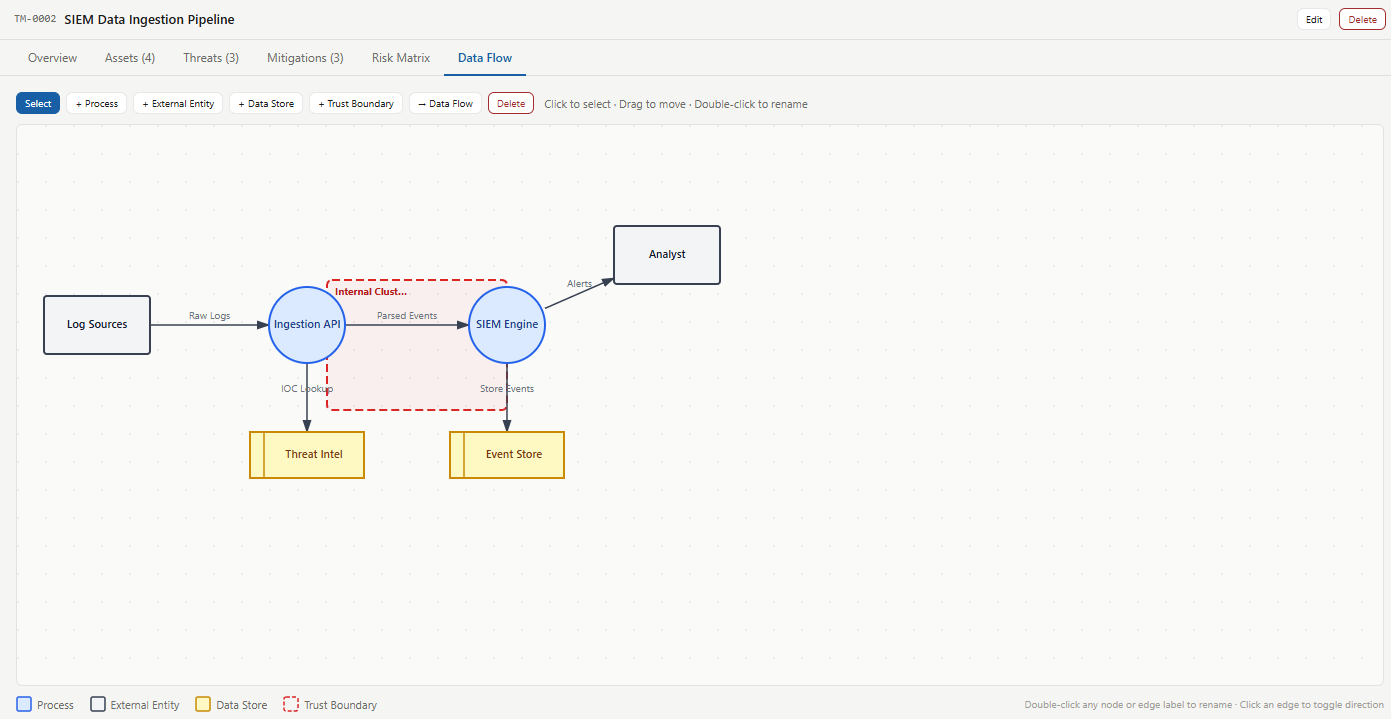
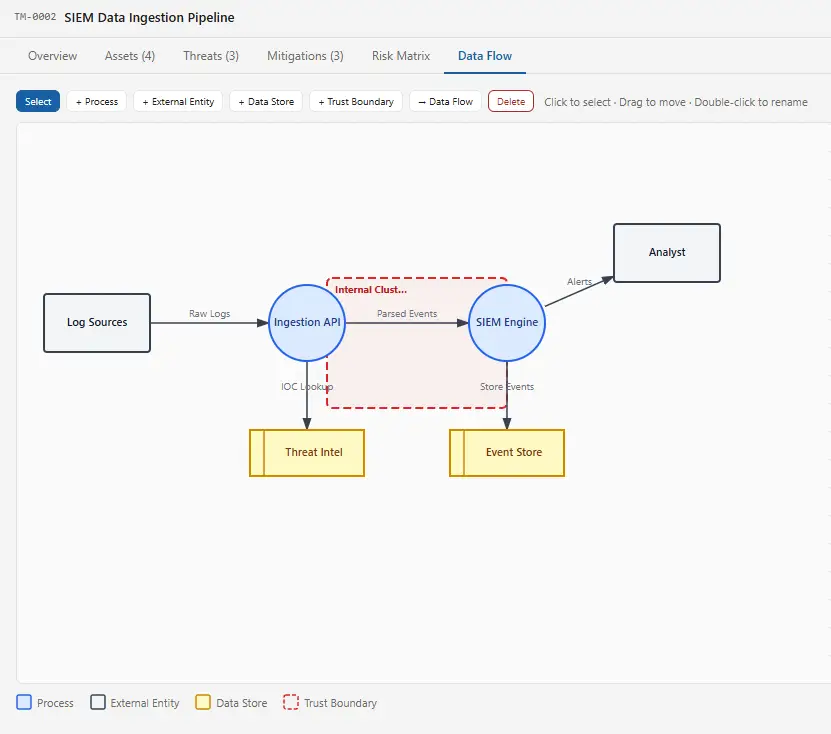
TIME provides a structured environment modeling workspace where analysts document the components of the organization's architecture — systems and applications, network zones and segments, trust boundaries where data or access crosses between zones of different privilege, high-value assets that represent the most likely adversary objectives, and data flows that carry sensitive information across boundaries. Each component carries attributes — criticality, owner, data classification, exposure level, and associated controls. The model is visual — rendered as a data flow diagram that shows every component, every boundary, and every flow in a single view that anchors every subsequent analysis. The environment model is a living document — updated as the architecture changes, as new systems are added, and as new trust boundaries are introduced by vendor integrations, cloud migrations, or acquisitions.
Map Every Known Adversary TTP Against Your Specific Environment.
A TTP library tells you what attackers do. A TTP mapping tells you what attackers would do in your environment specifically — which techniques would succeed against your architecture, which would be blocked by existing controls, which would go undetected by your current coverage, and which represent the highest-priority gaps given your specific threat actor profile. TIME connects the CIPHER entity registry to the environmental model — mapping every relevant actor TTP against every relevant component of your architecture to produce that specific, actionable picture.
TIME draws directly from CIPHER's entity registry to populate its threat actor and TTP library — every actor profiled in CIPHER, every TTP they are known to use, and every relationship edge that connects them is available in the TIME modeling workspace. Analysts select the threat actors most relevant to their organization — by sector targeting, by geographic focus, or by specific campaign activity — and map their known TTPs against the environmental model. Each TTP mapping produces an assessment — whether the technique would be prevented by existing controls, detected by existing detection coverage, or would succeed undetected given the current defensive posture. The mapping output is a prioritized gap register — every unmitigated, undetected technique ranked by likelihood and impact.
Six Threat Categories. Every Component Assessed. No Gap Left Unexamined.
STRIDE — Spoofing, Tampering, Repudiation, Information Disclosure, Denial of Service, and Elevation of Privilege — is the structured methodology that ensures no category of threat is overlooked when assessing a system or trust boundary. TIME integrates STRIDE analysis directly into the threat modeling workflow — applying the six-category framework to every component and every trust boundary in the environmental model to produce a systematic, comprehensive gap assessment that intuition and experience alone would never consistently achieve.
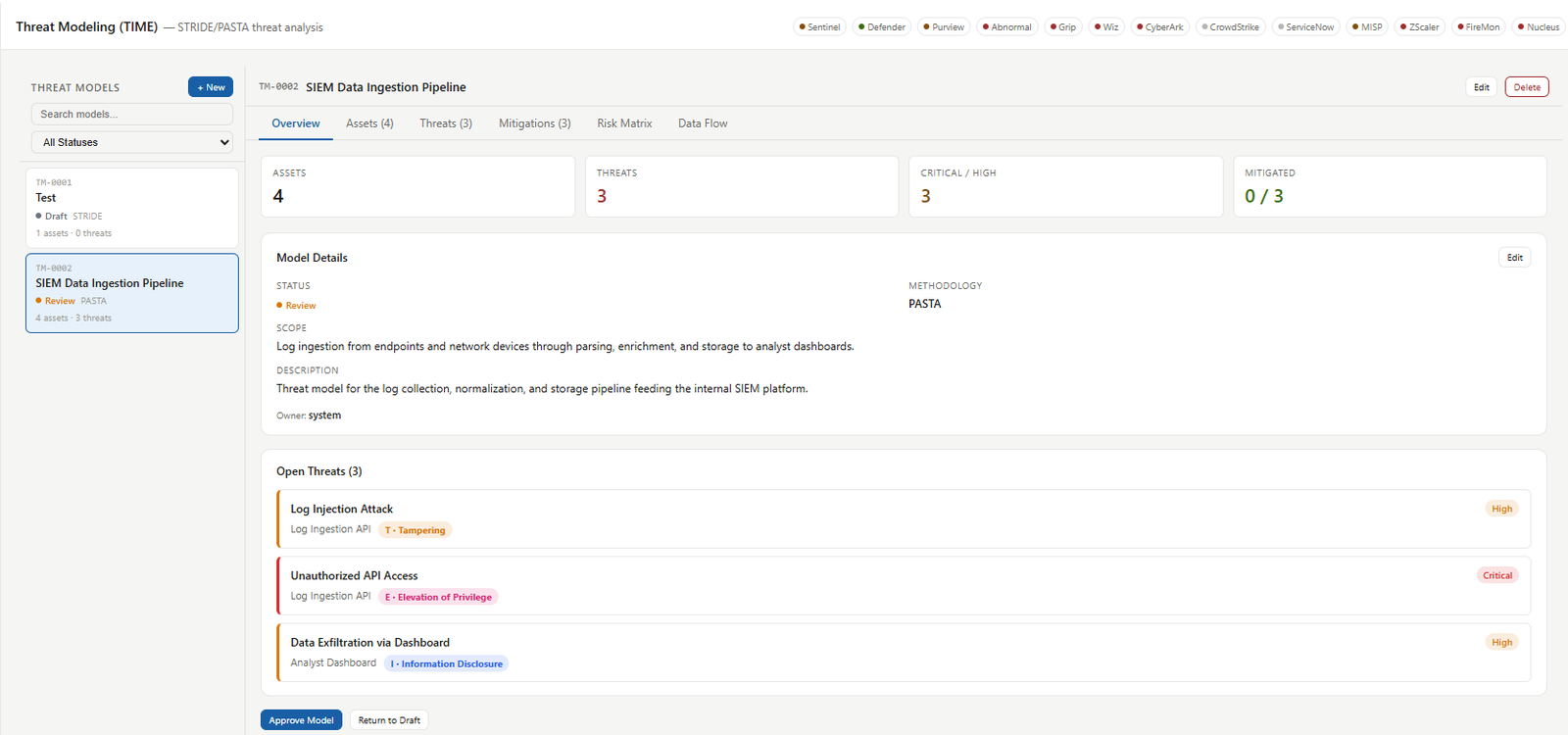
TIME applies STRIDE analysis to each element of the environmental model in turn — walking every process, every data store, every data flow, and every external entity through the six threat categories to identify which threats apply, which existing controls address them, and which represent unmitigated gaps. Each identified threat is documented with a description, the affected component, the STRIDE category, the likelihood and impact rating, the existing control assessment, and the recommended mitigation. The STRIDE analysis produces a structured threat register — every identified threat documented, assessed, and prioritized — that feeds directly into the gap register and the detection and hardening recommendations that close them.
Every Gap Identified. Every Gap Prioritized. Every Gap Owned.
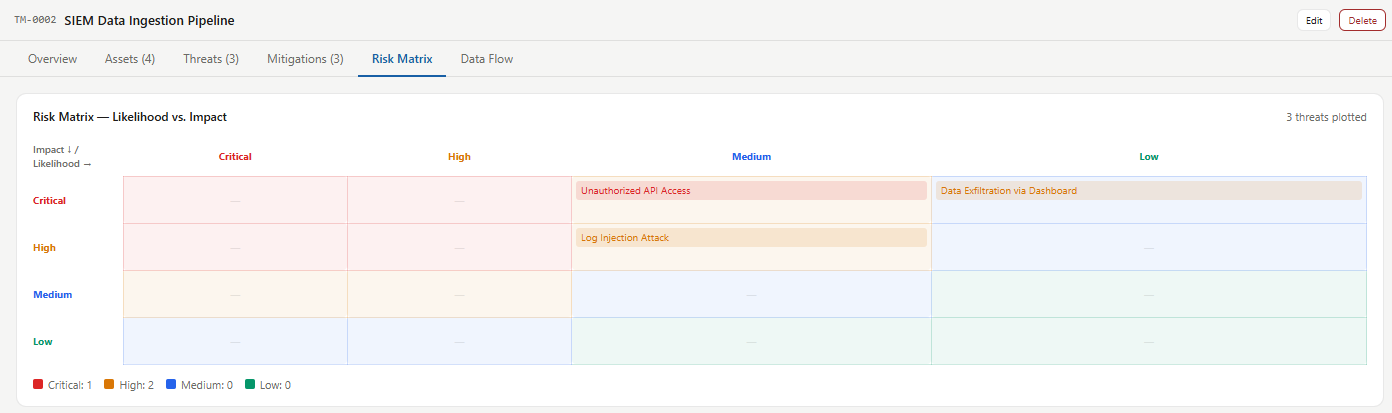
A threat model that produces findings without priorities is a document. A threat model that produces a prioritized, owned, tracked gap register is a program. TIME's gap register is the operational output of the modeling process — every unmitigated threat and every undetected TTP documented as a discrete gap with a severity rating, a likelihood assessment, an owner, a remediation recommendation, and a direct connection to the BLADE detection engineering request or hardening action that closes it.
The TIME gap register aggregates findings from three sources — TTP mapping gaps where known actor techniques have no detection coverage or mitigation, STRIDE analysis gaps where environmental components have unmitigated threats, and control validation failures where documented controls were assessed as insufficient for the threats they are supposed to address. Each gap carries a severity rating — Critical, High, Medium, or Low — derived from the likelihood of exploitation by a relevant threat actor and the impact if the technique succeeds. Gaps are assigned owners with remediation deadlines. Detection gaps route to BLADE as detection engineering requests. Hardening gaps route to the relevant system or asset owner as remediation tickets. The register tracks every gap from identification through remediation to validation — closing the loop between the threat model and the operational work that improves the defensive posture.
Believe Your Coverage Is Adequate. Then Prove It.
Most SOCs have a general sense of their detection coverage — the tools they have deployed, the rules they have written, and the techniques they believe they can detect. TIME turns that general sense into a validated, documented assessment — mapping every detection rule in BLADE against every TTP in the threat model to produce a coverage picture that shows exactly where the SOC can detect a known technique, where it cannot, and where the gap is most critical given the specific threat actor profile.
TIME draws BLADE's detection rule inventory into the coverage validation workspace — every active rule mapped to the MITRE ATT&CK technique it is designed to detect. The coverage validation compares that rule inventory against every TTP in the TIME threat model — identifying techniques that are covered by at least one active rule, techniques that have rules in development or testing, and techniques that have no coverage at all. Coverage gaps for techniques associated with high-priority threat actors surface as critical gaps in the TIME gap register and route automatically to BLADE as detection engineering priorities. The coverage validation updates dynamically as BLADE's rule inventory changes — ensuring the TIME coverage picture always reflects the current state of the detection program rather than a point-in-time snapshot.
A Threat Model That Goes Stale Is a False Sense of Security. TIME Prevents That.
A threat model reflects the environment it was built for and the threat landscape that existed when it was created. Both change continuously — new systems, new integrations, new vendors, new threat actors, new TTPs, and new vulnerabilities all alter the exposure picture that the model is supposed to represent. TIME manages the threat model as a living program — tracking changes, triggering reviews, and ensuring that the model always reflects the current environment and current threat landscape rather than a historical snapshot that gives a false sense of security.
TIME tracks the threat model lifecycle through a structured review cadence — quarterly reviews for the full model, triggered reviews when significant environmental changes are registered, and immediate gap register updates when new threat intelligence from CIPHER introduces a TTP that has no coverage in the current model. Each review produces a documented comparison between the previous model state and the current one — new components added, new TTPs mapped, gaps closed, gaps opened, and the overall change in exposure posture. Review history is preserved as an auditable record of how the threat model has evolved over time — demonstrating program maturity and providing the evidence base for investment decisions, compliance requirements, and board reporting.
The Threat Model That Drives Every Operational Decision Your SOC Makes.
A threat model that exists in isolation from the operational workflows it is supposed to inform is a compliance artifact. TIME is designed to be the opposite — an operational program whose outputs drive detection engineering priorities, hunting hypothesis development, incident response context, and intelligence collection requirements across every pillar of the SCOUT platform. The value of TIME is not in the model it produces — it is in the operational change that model drives.
TIME integrates directly with every pillar in the SCOUT platform through a shared gap and intelligence layer. BLADE receives detection gap findings as engineering requests — every undetected TTP in the TIME gap register surfaces in BLADE's request queue with priority, actor attribution, and TTP detail. PROWL receives gap findings as hunting priorities — high-priority undetected techniques with no detection rule surface as hypothesis starting points grounded in the threat model. CIPHER receives gap findings as PIR inputs — unaddressed intelligence questions identified during modeling feed into the PIR collection program. SHIELD receives threat model context during active incidents — the blast radius assessment and actor TTP profile from TIME inform containment scope and eradication priorities. FLARE receives asset criticality context from TIME — high-value assets registered in the model receive elevated alert priority for relevant techniques.
How TIME works
From Environment Map to Closed Gap — Every Step Structured, Every Output Operational.
Scope Defined
Environment Mapped
Threat Actors Selected
TTPs Mapped
STRIDE Analysis Applied
Controls Assessed
Gap Register Built
Detection Gaps Routed to BLADE
Hunting Priorities Fed to PROWL
Incident Context Provided to SHIELD
Model Reviewed and Updated
Posture Tracked Over Time
Frequently Asked Questions
If your organization runs threat modeling exercises that produce reports nobody acts on, gap registers nobody owns, and findings that never connect to a detection rule or a hunt hypothesis — TIME was built for exactly that problem. Here are the questions security architects, SOC leads, and CISOs ask most often about how TIME turns threat modeling from a periodic exercise into a continuous operational program.
TIME — Threat Intelligence Modeling Engine — is SCOUT's threat modeling pillar. It gives SOC teams a structured platform to map their environment against known adversary TTPs, apply STRIDE analysis to every component and trust boundary, identify where defenses have gaps, and produce a prioritized gap register that drives detection engineering, hunting priorities, hardening decisions, and incident response context across the full SCOUT platform. TIME transforms threat modeling from a periodic compliance exercise into a continuous operational program.
A traditional threat modeling exercise produces a report. TIME produces a program. The difference is operational integration — every gap identified in TIME connects directly to the BLADE detection engineering request that closes the detection gap, the PROWL hypothesis that hunts for the undetected technique, the CIPHER PIR that collects the missing intelligence, and the SHIELD context that informs the incident response. TIME does not just describe the exposure — it drives the work that reduces it, continuously, across every pillar of the SCOUT platform.
The environmental model is the structured documentation of the organization's architecture — every system, every network zone, every trust boundary, every data flow, and every high-value asset, with attributes covering criticality, owner, data classification, exposure level, and existing controls. It is the foundation that makes TIME's analysis specific to the organization rather than generic to its industry. Two organizations with the same threat actor profile can have fundamentally different exposure profiles depending on their architecture — the environmental model captures that specificity and ensures every analytical output reflects it.
TIME draws directly from CIPHER's entity registry for its threat actor and TTP library. Every actor profiled in CIPHER, every TTP they are known to use, and every relationship edge connecting them is available in the TIME modeling workspace. When CIPHER generates a new profile or updates an existing one with new TTP intelligence, TIME's threat model updates to reflect the change — ensuring the gap analysis is always based on current intelligence. The pipeline is automatic — no manual cross-referencing, no browser tab switching, no intelligence that gets overlooked because the modeler did not know to look for it.
STRIDE — Spoofing, Tampering, Repudiation, Information Disclosure, Denial of Service, and Elevation of Privilege — is a structured threat analysis framework that ensures every category of threat is assessed for every component of the architecture. TIME applies STRIDE analysis to each element of the environmental model in turn — every process, every data store, every data flow, and every external entity assessed against all six categories to identify which threats apply, which controls address them, and which represent unmitigated gaps. STRIDE analysis is the complement to TTP mapping — where TTP mapping identifies actor-specific techniques, STRIDE identifies structural threats inherent to the architecture regardless of the attacker.
The gap register consolidates every finding from TTP mapping, STRIDE analysis, and control validation into a single prioritized register. Every gap carries a severity rating — Critical, High, Medium, or Low — derived from the likelihood of exploitation by a relevant threat actor and the impact if the technique succeeds. Every gap is assigned an owner and a remediation deadline from the moment it enters the register. Detection gaps route to BLADE as engineering requests. Hardening gaps route to the relevant system owner as remediation items. The register tracks every gap from identification through remediation to validation.
Every gap in the TIME register where the identified threat has no detection coverage routes automatically to BLADE as a detection engineering request — specifying the technique, the threat actor known to use it, the environmental component it targets, and the priority level. BLADE's engineering team receives a prioritized, intelligence-grounded queue of detection requests that reflects the actual threat model rather than general best practices. As BLADE builds new detection rules, the coverage picture in TIME updates dynamically — the gap register reflects the current state of detection coverage in real time.
High-priority undetected techniques — those with no detection rule and high likelihood of exploitation by a relevant threat actor — surface in PROWL's hypothesis development workspace as priority hunting targets. The hunter who opens a new hypothesis finds TIME's gap register feeding the most critical undetected techniques directly into the starting point. Every hunt that confirms a gap technique validates the threat model and triggers the detection engineering request that closes the detection gap permanently. TIME and PROWL together close the loop between modeling exposure and actively hunting for evidence of exploitation.
When an active incident involves a threat actor or technique present in the TIME threat model, SHIELD surfaces the relevant model context in the incident workspace — the blast radius assessment for the affected component, the actor's full TTP profile, the controls that should have prevented or detected the technique, and the gap register status for the confirmed technique. The response team understands not just what happened but what the model predicted about this actor's behavior — informing containment scope, eradication priorities, and the investigation of lateral movement paths identified in the environmental model.
TIME manages the threat model through a structured review cadence — quarterly reviews for the full model, triggered reviews when significant environmental changes are registered, and immediate gap register updates when new CIPHER intelligence introduces a TTP not currently covered by the model. Each review produces a documented comparison between the previous state and the current one. Review history is preserved as an auditable record of how the model has evolved — demonstrating program maturity and providing the evidence base for investment decisions and compliance reporting.
Every completed review produces a posture snapshot — total gaps in the register, distribution by severity, gaps closed since the last review, and new gaps identified. Posture trending shows whether the organization's exposure is improving, stable, or degrading over time. A shrinking gap register with accelerating closure rates is the measurable evidence that the program is working — and the data that CISOs need to demonstrate security program progress to boards, regulators, and insurers with evidence rather than narrative.
Yes. TIME supports both full environment threat modeling and scoped system-level modeling for new deployments. When a new system or integration is being assessed before it goes live, TIME provides a structured workspace to model its components, map the trust boundaries it introduces, apply STRIDE analysis to its architecture, and identify the gaps it creates before it is connected to the production environment. The findings feed directly into BLADE for pre-deployment detection coverage and into the hardening requirements for the system's secure deployment — shifting threat modeling left without requiring a separate toolset.
TIME's gap register, review history, control validation records, and posture trend data collectively produce the documented evidence that compliance frameworks and security auditors require — evidence that threat modeling is conducted systematically, that findings are tracked to remediation, that controls are validated rather than assumed, and that the program improves over time. The review audit trail demonstrates cadence and rigor. The gap register demonstrates systematic gap identification and ownership. The posture trend demonstrates measurable improvement. Together they tell the compliance story that narrative alone cannot.
TIME sits at the strategic center of the SCOUT platform — the program that tells every other pillar where to focus. BLADE receives detection gap priorities. PROWL receives hunting hypothesis starting points. CIPHER receives PIR inputs for missing intelligence. SHIELD receives blast radius and actor context for active incidents. FLARE receives asset criticality data for alert prioritization. Every gap TIME identifies drives work in at least one other pillar — and every finding those pillars produce feeds back into TIME to validate the model, close gaps, and improve the posture picture that TIME maintains.
Discover the Impact of SCOUT Through Video or a Live Demo
Every sophisticated attacker begins with reconnaissance. They map the environment, identify the trust boundaries, locate the high-value assets, and plan the path of least resistance to their objective — before they execute a single technique. The reconnaissance phase is methodical, patient, and entirely invisible to alert-driven security operations. By the time the first alert fires, the mapping is already complete.
The question TIME asks is simple: why should the attacker be the only one with a map?
Structured threat modeling — grounded in real threat intelligence, applied to your specific environment, and connected to the operational workflows that act on its outputs — gives the SOC the same visibility the attacker develops during reconnaissance, from the defensive side. Every trust boundary documented. Every high-value asset registered. Every adversary TTP mapped against your specific architecture. Every gap between your current defensive posture and the techniques your most likely threat actors would use to exploit it — identified, prioritized, owned, and tracked to closure.
TIME is not a threat modeling tool. It is a threat modeling program — one whose outputs drive detection engineering priorities in BLADE, hunting hypothesis development in PROWL, intelligence collection requirements in CIPHER, incident response context in SHIELD, and alert prioritization in FLARE. Every gap TIME identifies becomes work that closes it. Every piece of work that closes a gap updates the model. The program improves continuously — the gap register shrinks, the coverage picture improves, and the posture trend tells the story of a SOC that is operating ahead of the threat rather than behind it.
If your organization runs threat modeling exercises that produce reports nobody acts on — TIME was built to change that. Not by making the reports better, but by making the outputs operational. The gap register is not a document. It is a work queue. And every item in that queue is connected to the pillar that closes it.
SCOUT is available now. Watch the full platform demonstration and see TIME in action — from environmental model construction to TTP mapping, STRIDE analysis to gap register prioritization, detection gap routing to posture trend tracking. One hour. Seven pillars. Everything your SOC has been missing.






Operate Ahead of the Threat.
SCOUT is a unified SOC platform with seven purpose-built pillars — covering every workflow from alert triage to detection engineering — built by analysts, for analysts, at the speed modern threats demand.
Rated 4.9 of 5
SCOUT © All rights reserved
